
 Caps of the Soviet Air Force
Introduction
Covered here are caps worn by the Soviet Air Force (VVS) and Airborne Troops during the Cold War. Long considered "elite," Air Force officers often were the first within the military to acquire new, more decorative uniforms and insignia. Dark blue parade uniforms offset with light blue edgings/bands, enabled Air Force officers to easily stand out from the rest of the military services. Because of their attractiveness, KGB and GRU officers often chose Air Force uniforms to wear when on overt duty in Western countries. Air Force conscripts, on the other hand, typically wore standard Army uniforms with light blue distinctions. For the first half of the Cold War period, Airborne troops wore Army uniforms and color distinctions (most commonly that of Rifle Troops, but also artillery, motor transport, engineering, etc) with airborne insignia. But in 1963 they adopted VVS uniforms; again with airborne insignia. Caps of the two arms were indistinguishable; so while I describe the following caps usually just as "Air Force, " recognize that Airborne officers and troops would also have worn these after 1963. Readers should also know that when I discuss "general" caps, I am also describing those of Marshals' and Chief Marshals' of Aviation - which were indistinguishable. Thumbnail images accompany each cap description. Clicking on those thumbnails will bring up a larger, higher resolution image.
Soviet Air Force marshals and generals had a surprisingly large variety of uniforms and component visor caps in the post-WW2 period. Although many of the following caps are not in my personal collection, I've included them to enable the reader to see how these caps evolved over time and to clear up some misperceptions as to colors and insignia. One word of caution: Air Force caps are HEAVILY faked; especially WWII-style ones with spade-shaped visors!
 Air Force
General Parade
1945-1947
As Army generals and marshals wore new wave green (AKA "Tsar" green) parade uniforms at the various WW2 victory parades in 1945, so too did Air Force general officers. This uniform was short-lived in Air Force service, however, lasting only until 1948 when it was replaced by a khaki dress uniform. That in turn lasted just a few more years until the signature dark blue parade uniform was introduced for Air Force generals that lasted until the collapse of the USSR.
Shown here is a cap from the Sinclair Collection (from the book World War II Parade Uniforms of the Soviet Union - Marshals, Generals and Admirals).
The crown is wave green and both band and piping are light blue (azure) - the distinguishing color for the Air Force for the entire Cold War period.
Stylized laurel leaves are embroidered directly onto the band in gilt wire, while a gilt wire wreath with light blue "ties" at the bottom are either embroidered directly or sewn as a separate
emblem onto the band. This wreath in turn surrounds a round one-piece M-1943 Air Force generals cockade, with its light blue background and gilt edging.
Gilt filigree cords are held in place above a rounded black-painted fiberboard visor by two brass buttons embossed with the Great Seal of the USSR.
Notice there was NO embroidery on the visor during this period. The lack of wings on the crown was a particular regulation feature of this cap; in contrast to all other Air Force caps which distinguished flight/non-flight status by their wear.
Very Rare
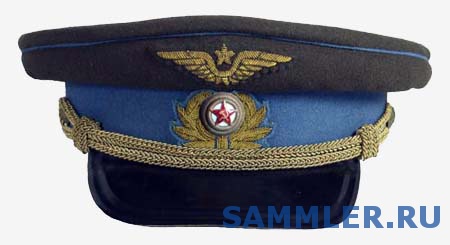
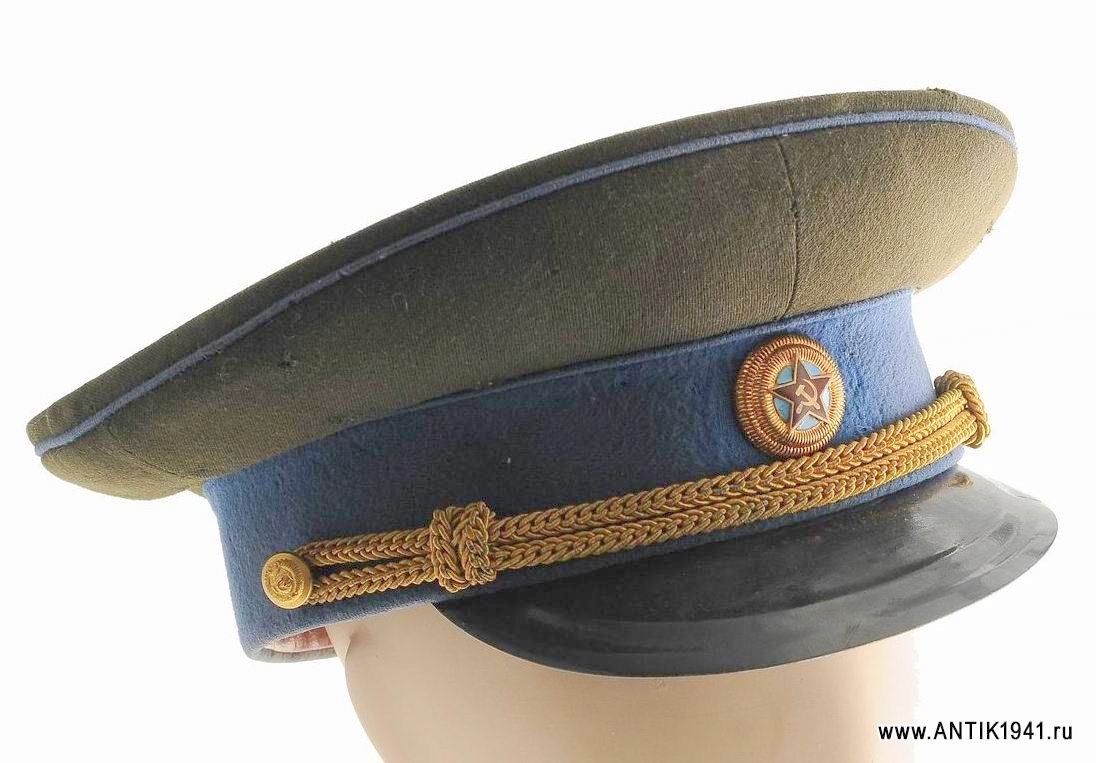 Air Force
General Service
1943-1948
The caps shown here were part of a general's service/everyday uniform. Although not authorized, photographs also show them being worn with field uniforms. The cap on the left was for a flight officer (which included operational staff) and on the right, for a non-flight officer such as a commander of a support or administration unit. Both caps have khaki crowns and azure bands and piping. They also both use gilt filigree cords looped over brass general buttons (although pictures also show that non-regulation black chinstraps were also worn by generals on occasion, whether by choice or dictated by availability of the gold cords is unknown. Generals in all armies have a little leeway in following regulations!).
The differences signifying flight and non-flight officers are just as obvious. The flight/operations general has a wing and star emblem embroidered in gilt wire onto a woolen backing and sewn to the crown. He also has an embroidered wreath surrounding his M43 general's cockade,
which is also sewn as a "patch" onto the band (although the background on the M43 cockade of this cap from the sammler.ru site appears white, it is actually light azure).
In contrast, the admittedly bleached out photograph on the right from www.antik1941.ru simply has the M43 cockade pinned to the band with no other insignia. This was regulation for non-flight generals.
Both visors are black painted fiberboard; while spade-shaped ones were most common in the 1940s, some generals apparently had a preference for the rounded ones (once again, the privileges of rank!).
Rare
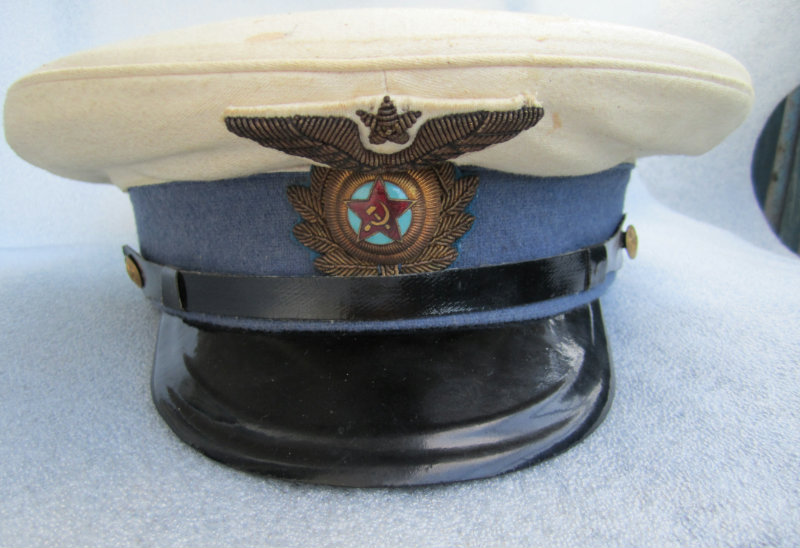
|
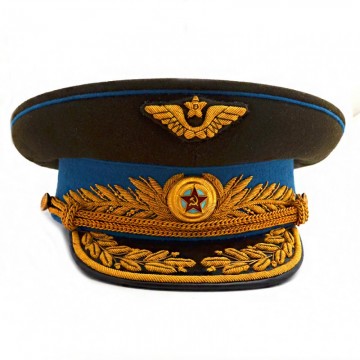
1943 regulations also authorized generals to wear a white cover over the crown of their M43 khaki service cap - as shown in the photograph here - which would last until 1949. These covers were apparently worn both with and without the embroidered wing emblem. The use of a black chinstrap vice gold cords is non-regulation. |
 Air Force
General Parade
1949-1954
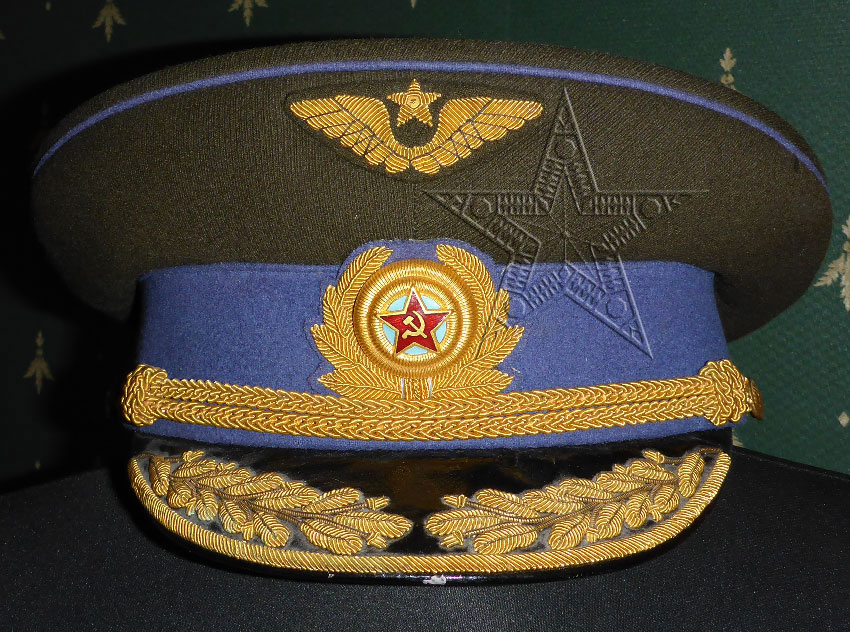
In 1949, the Air Force adopted a khaki parade uniform for its generals (replacing the 1945 wave green) and introduced visor embroidery on all their caps. Shown is a parade cap from Zemlyanka-v.ru showing these changes. The crown is khaki, band and piping are azure. The band has the same stylized laurel leaf embroidery as on the M43 parade cap, with the same M43 cockade. The embroidered gilt wings on the crown and the wreath surrounding the cockade in the middle of the band embroidery signify the owner was a flight or operational command officer. Filigree cords and general-grade buttons are standard. Visor embroidery in gilt wire is present for the first time on Air Force generals' caps - consisting of perimeter cording encompassing stylized oak leaves and acorns. To physically permit this embroidery, the visor was changed from fiberboard to leather (or simulated leather). 1949 regulations mandated spade-shaped visors, but this was changed in 1954 to rounded ones - with all other elements remaining the same until 1955 eliminated the khaki parade uniform.
Non-flight generals were authorized this same cap but without the wreath surrounding the M43 cockade and without the wings on the crown.
Very Rare
 Air Force
General Service
1949-1954
In addition to the parade uniform discussed above, a new open-collar khaki service uniform was introduced for Air Force generals in 1949.
The caps for this uniform were very similar to that of the parade, but without the laurel leaf band embroidery. Shown here is a photograph from
antiqrussia.ru showing one such cap from this period. As with the parade cap, flight status is indicated by the wings embroidered onto a khaki backing and then sewn to the crown and by the
gilt wreath embroidered onto an azure backing. The rest of the cap is as for its parade counterpart.
Very Rare
 Air Force
General Summer Service
1949-1954
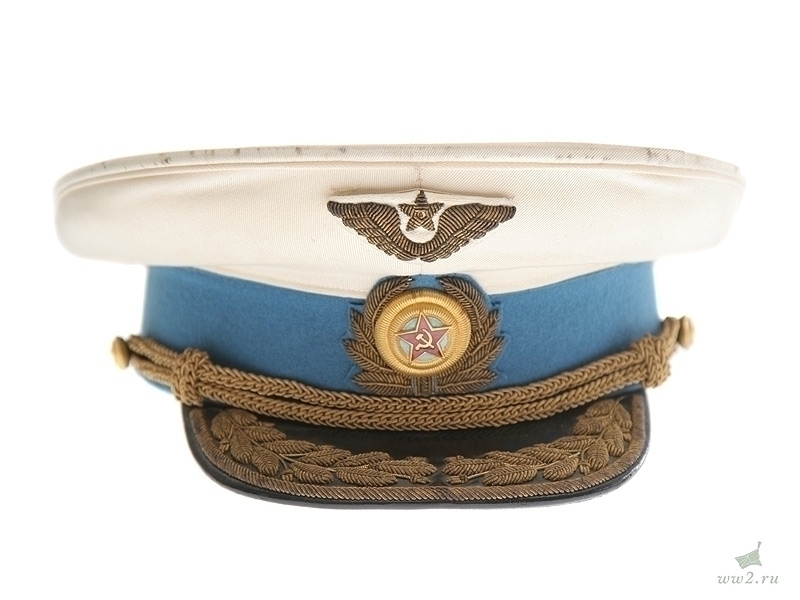
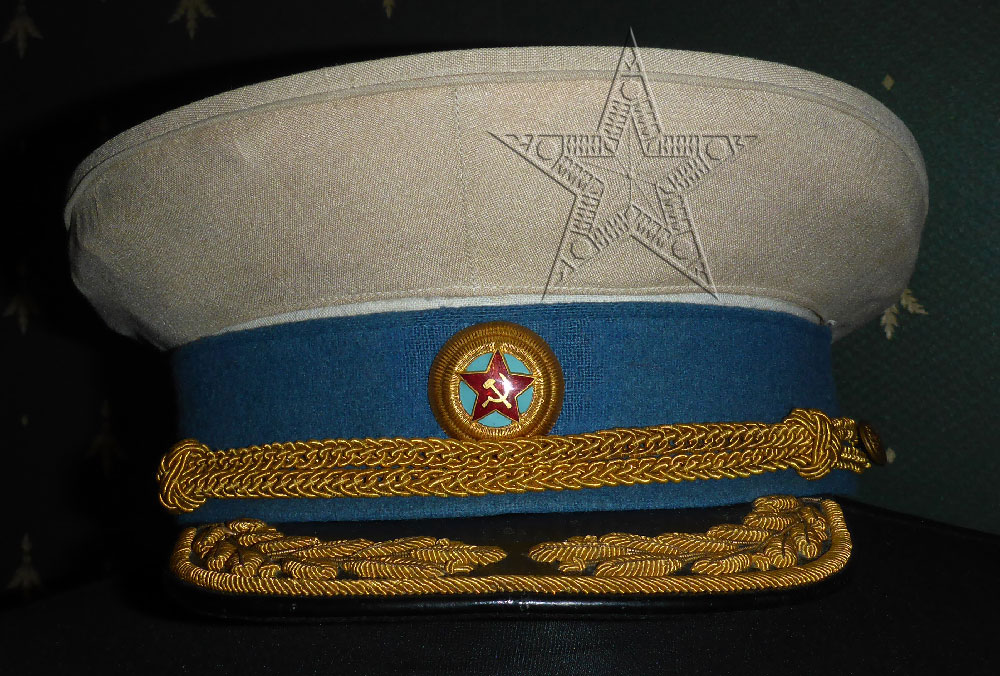
Shown here are both versions of the M-1949 general's summer service cap. To the left is that for flight qualified personnel and to the right is that worn by non-flying personnel.
As you can see on the left from ww2.ru, only the white cover differs from the cap just discussed above. The wings are, however, not permanently sewn to the crown; being instead "tacked" to allow
removal for washing. The cap on the right from antiqurussia.ru shows the less-ornate version worn by support and administrative generals. No wreath surrounds the M43 cockade and no wings are
worn on the crown.
Very Rare
 Air Force
General Parade-Walking Out
1955-1991
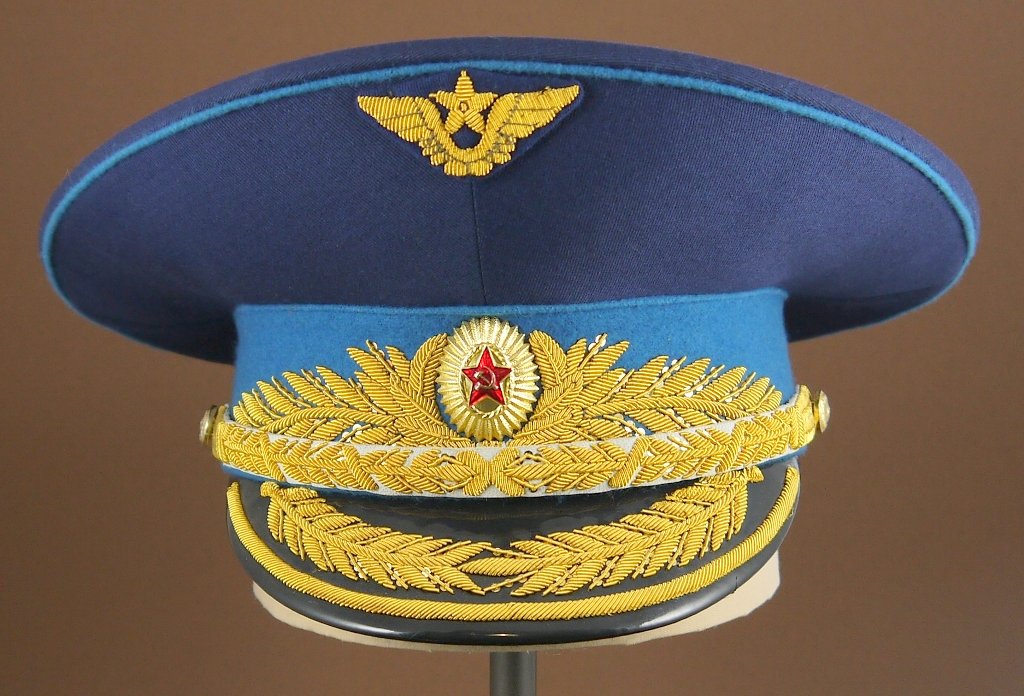
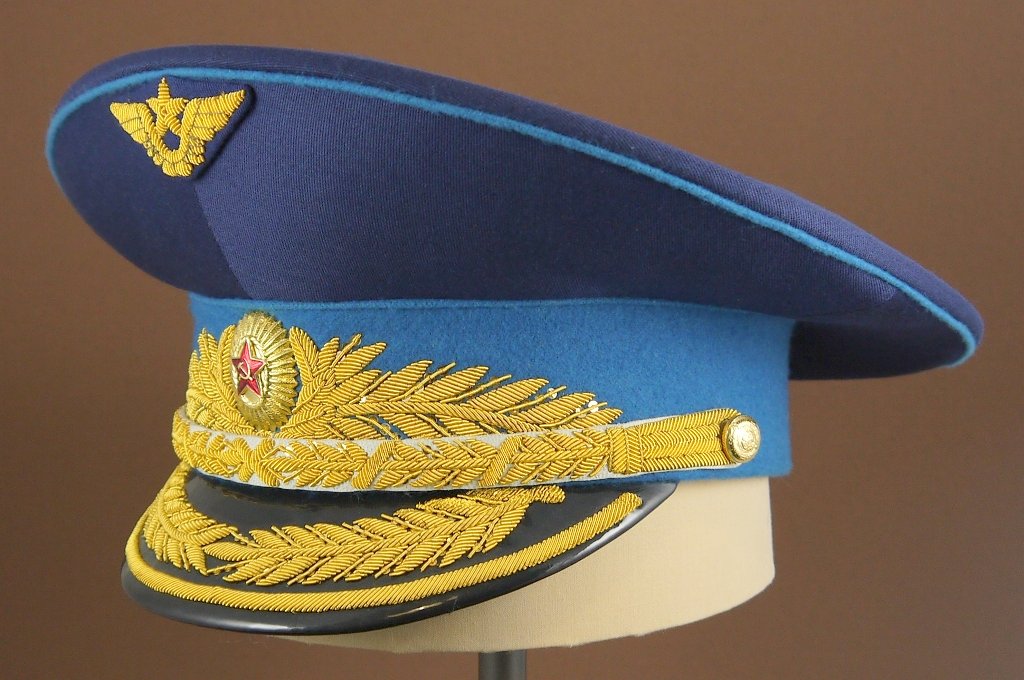
Another major change occurred in generals' uniforms in 1955, when dark blue parade uniforms were introduced - replacing the short-lived khaki ones. These uniforms remained in service with small updates until the end of the Soviet Union. Although crown sizes went through at least three ever-larger iterations (1955/1969/1989), otherwise caps were largely identical regardless of when in this time range they were produced. However, experts can also identify changes in the quality of the embroidery, interior markings and in the construction of the cockade and buttons.
The cap shown here is one the last production versions. Reflecting its ceremonial role, it carries gilt wire embroidery on four areas - visor, leather chinstrap, band and the wings on the crown. The oak leaves previously depicted on M49 generals' visors were exchanged for laurel leaves that complement those already used on generals' bands. The visor is simulated leather, covered underneath in black wool. The cockade is the all-gilt and red paint oval M-1955 general's model. Reflecting the late production of the cap, this cockade is one of the last aluminum versions with a brighter shine. The buttons are also some of the last ones; made of gilt plastic. Being a model 1989 cap - the crown has the larger height and circumference associated with that style.
This style cap was also worn with the light gray cap walking-out uniform starting in 1980 after the light gray cap was phased out of wear.
Early Versions: Rare; Late Versions: Scarce
 Air Force
General Service
1955-1968
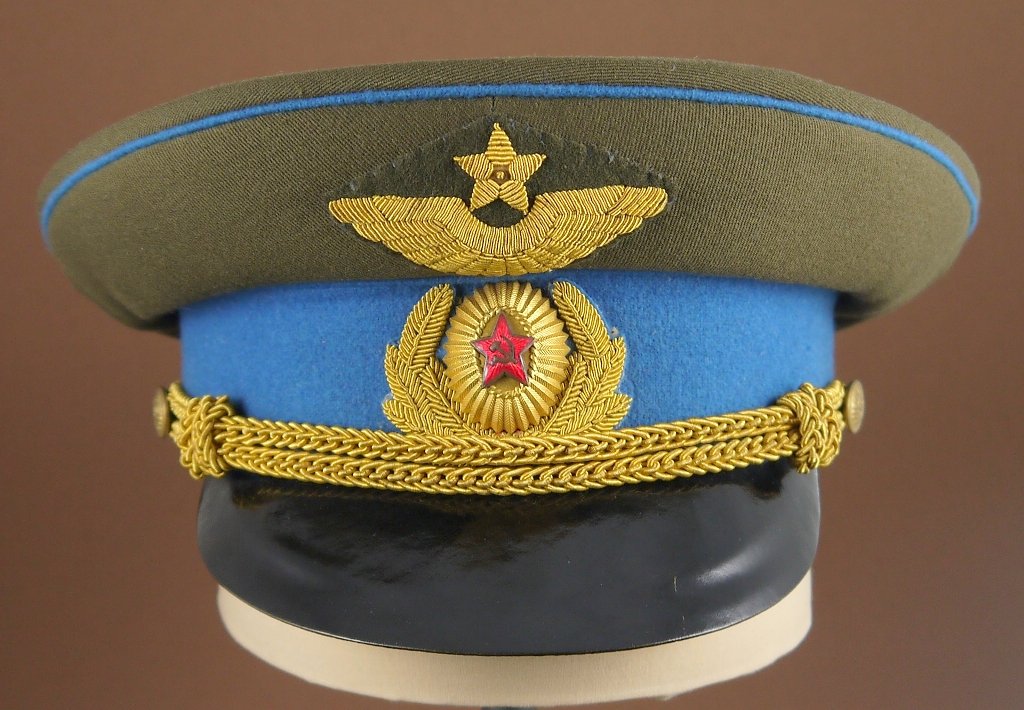
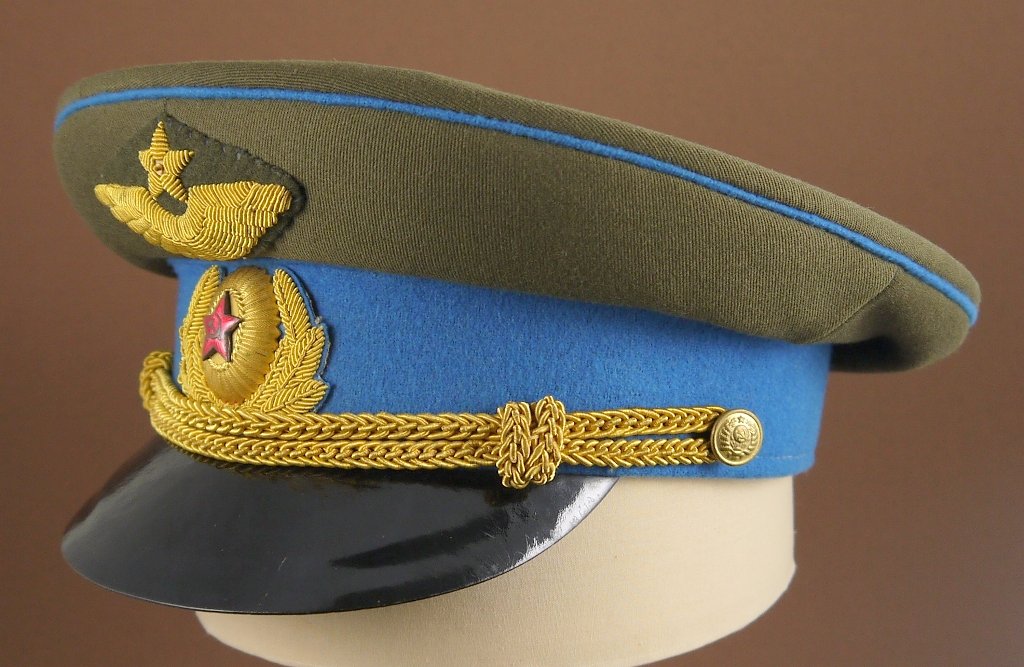
Even as the 1955 uniform regulations introduced generals' dark blue parade uniforms, they simplified khaki service uniforms. For example, no longer did service caps have visor embroidery. The resulting style remained unchanged until 1969 when larger crowns and cheaper materials were introduced. This 1950s' produced example has a khaki wool crown, azure band and piping, and black painted fiber visor. It also mounts an early M55 two-piece tombac general's cockade in a very rich gold color with hot enameled red star, gold cords and buttons stamped with the Great Seal of the Soviet Union.
Interestingly, although it has all high-grade general-officer accessories, the cap itself is standard officer-grade, without the unique general-officer interior. This suggests
it once belonged to a colonel who then upgraded it once he was promoted to general.
Scarce
| Starting in 1957, all Air Force officers were authorized to wear wings on the crowns and wreaths on the bands of their caps. This eliminated the flight/non-flight cap ornamentation differentiation that had been in place since before WW2. |
 Air Force
General Summer Service (Gray)
1955-1968
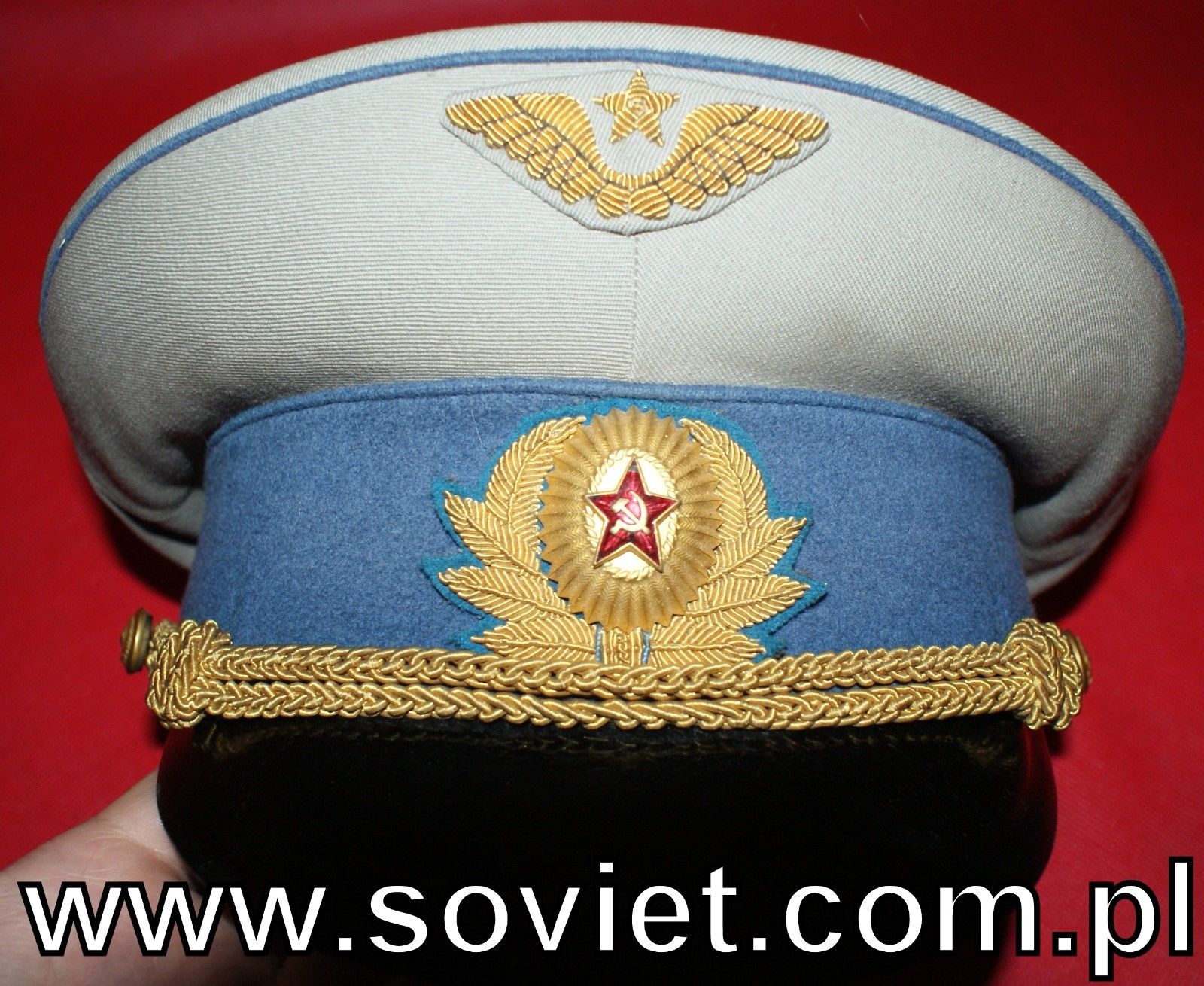
This cap from the www.soviet.com.pl website was part of the general's light gray alternative summer service uniform, although it also served as an informal "walking out dress" uniform for attending social functions and
civilian activities. Except for the color of the crown fabric, this cap mirrors that of the khaki service - although the style of the wings varies.
Rare
 Air Force
General Service
1969-1979
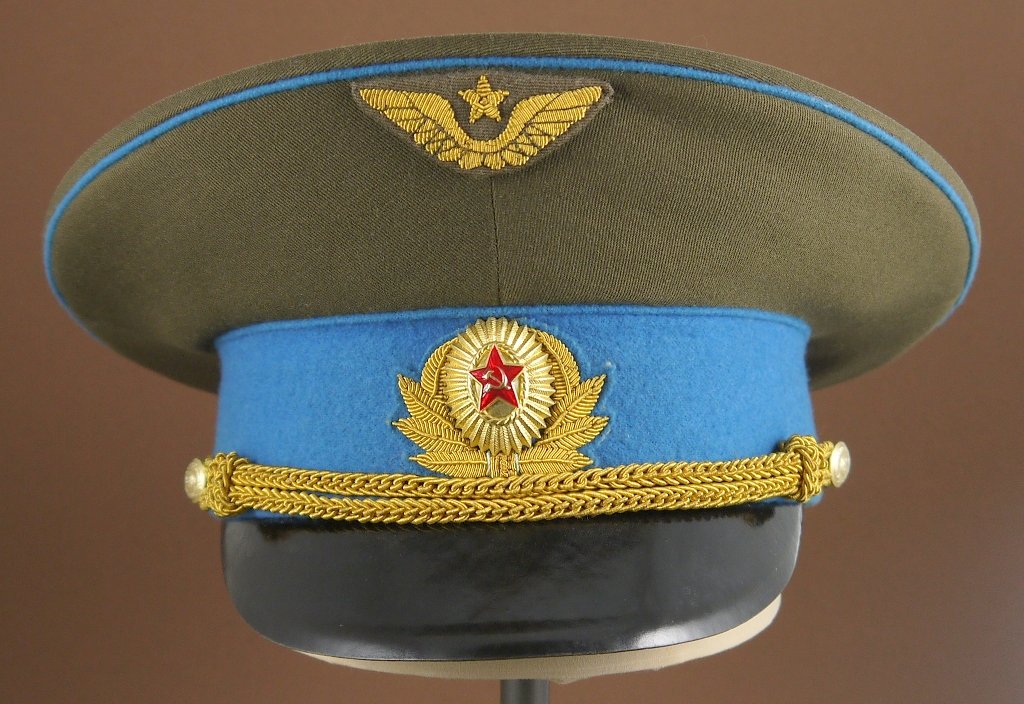
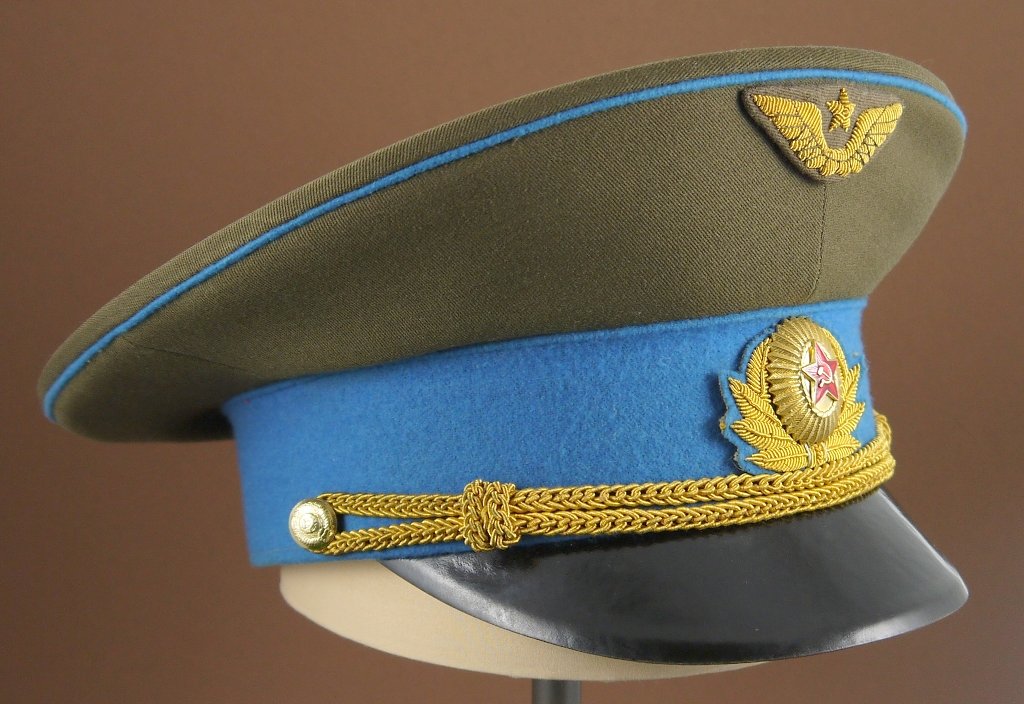
The successor to the above cap - this 1975-dated cap served as generals' everyday wear until 1980 regulations extended band embroidery to service caps.
Notice the embroidered wings are smaller and less ornate than on the previous cap. The all gilt cockade is still two-piece, but is now aluminum.
The wreath around the cockade on this cap is embroidered onto an azure backing that is then sewn onto the band. The buttons are plastic and the visor is black fiberboard. The crown is larger, reflecting M1969 increases in height and circumference.
Again - don't forget that Airborne generals wore the same caps as their Air Force compatriots.
Scarce
 Airborne
General Field
1969-1989
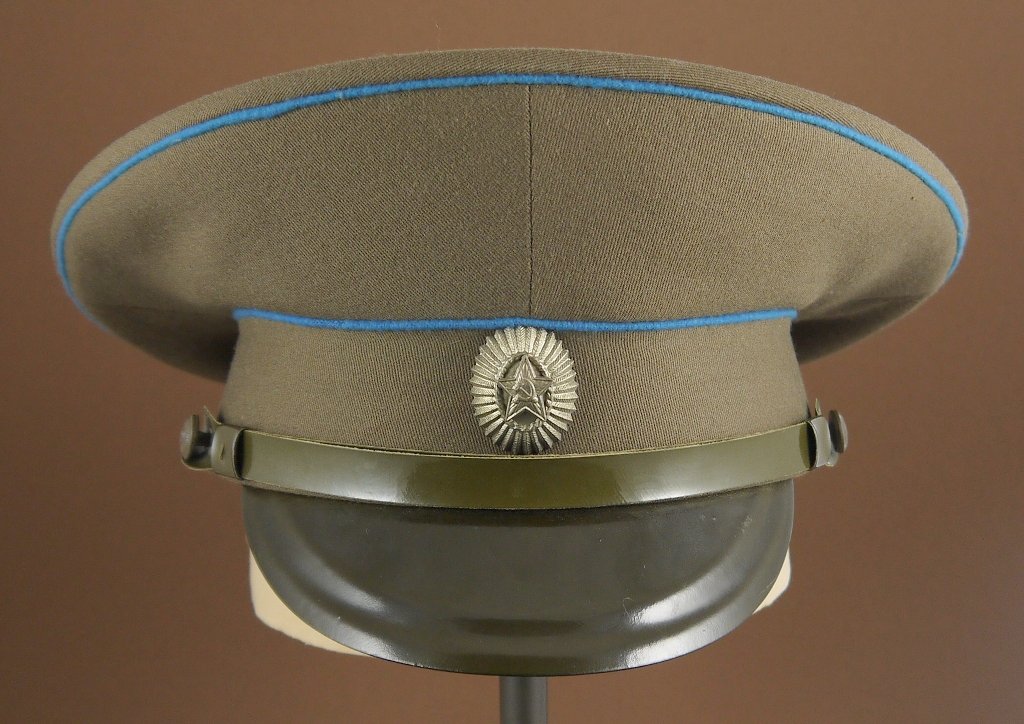
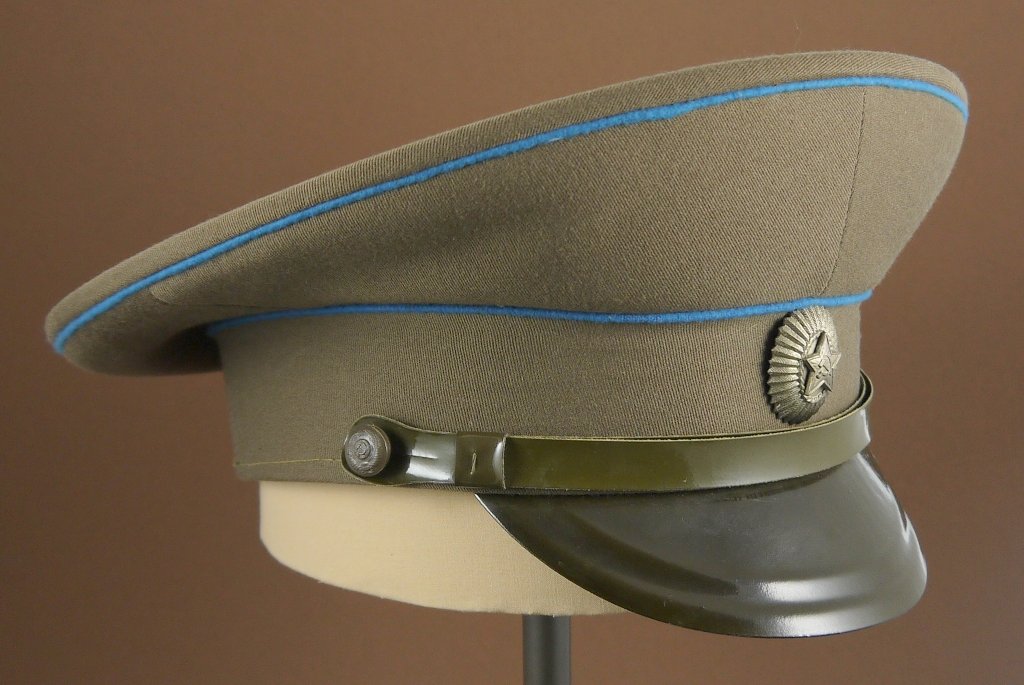
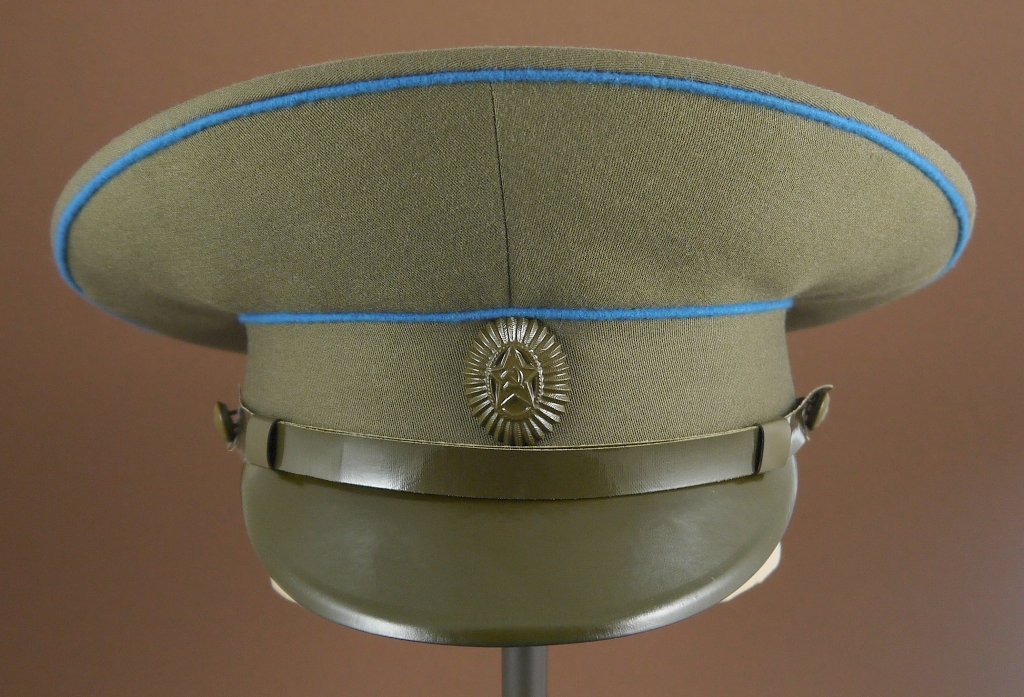
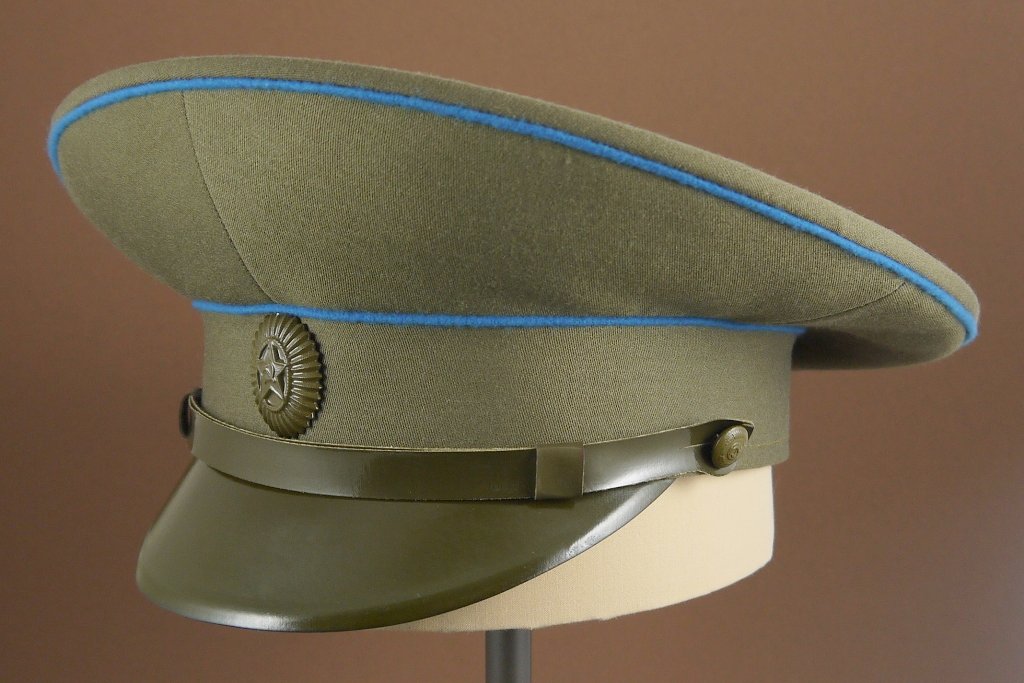
Shown here are two different Airborne generals' (or Air Force - although they seldom wore field uniforms) field caps. When field caps were re-introduced in 1958 all piping was in khaki - regardless of the owner's service or rank.
But in 1969 colored piping was introduced for generals; azure for Air Force/Airborne and red for Army generals. These two caps differ only in details - reflecting different production dates: 1976 for the cap on the left, 1984 on the right.
The earlier made cap has a black fiber visor; which, although not regulation, was common on early caps. The visor is a two-rim model; common in the 60s but being phased out in favor of single-rim visors in the 70s. The cap on the right has the more common green-painted single rim fiber visor.
Another point of variance is the cockade. The early cap has a two-piece green-anodized aluminum cockade while the later cap has a painted single-piece one. The cap on the right is also a bit larger than the one on the left - even though they are both size 59. Such gradual crown enlargement
can be seen on caps manufactured in the late 1980s and 1990s (or even 1984 in this case!).
Available
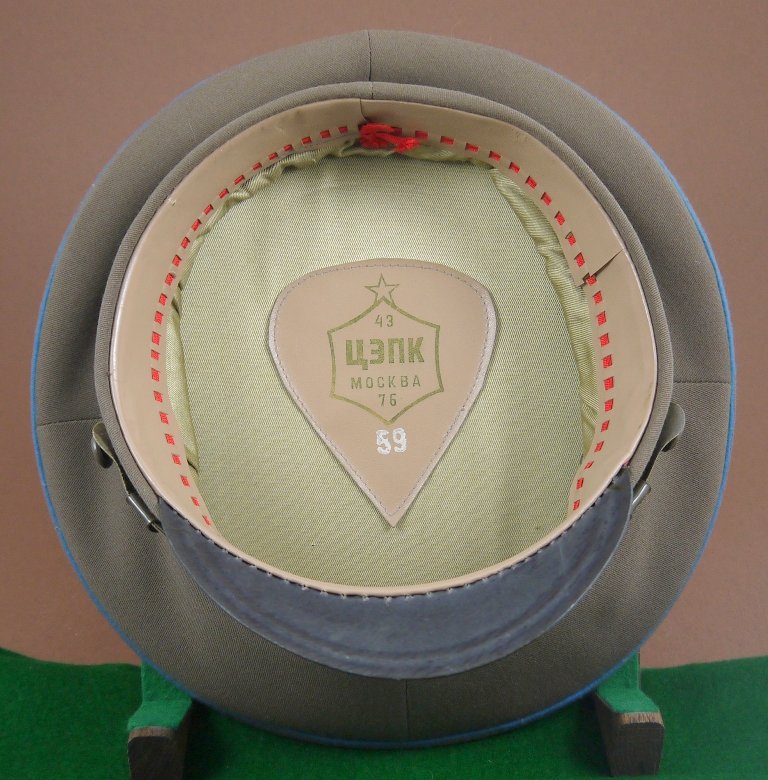
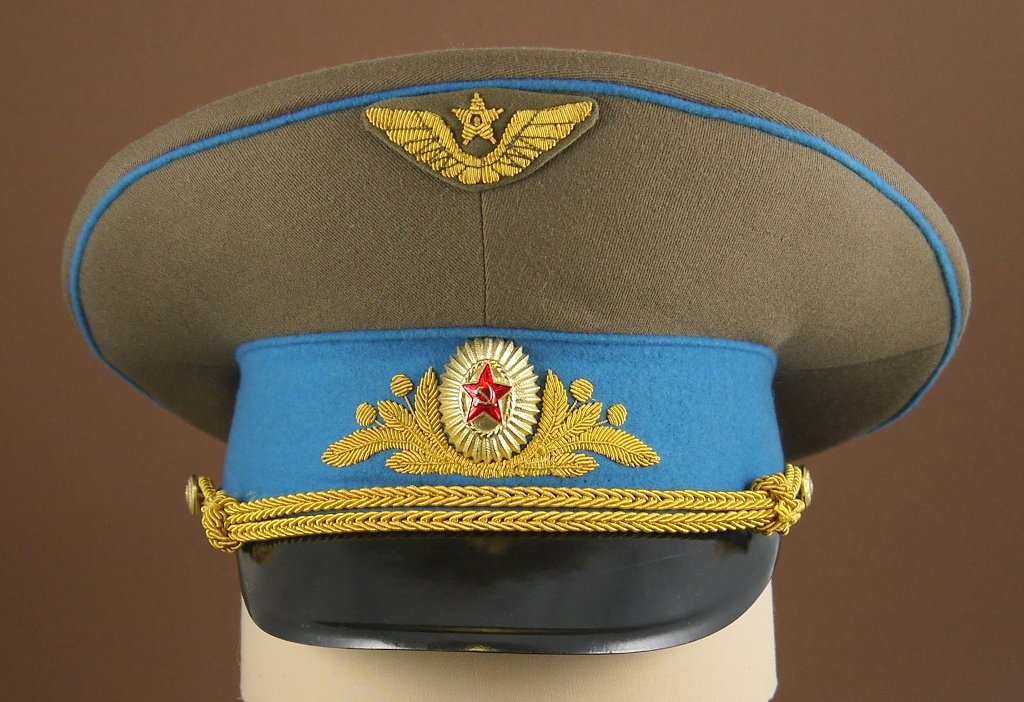
| To illustrate how variations crept into cap production during the USSR period, shown below are the insides of these two generals' field caps. Both were made at the "43rd Central Experimental Manufacturing Plant" in Moscow, but have different shaped makers' labels and different colored silk linings, leather sweatbands and ribbons. You can even observe these type variations in caps made the same year - everything depended on what materials were available or what sub-contractors provided the components. |
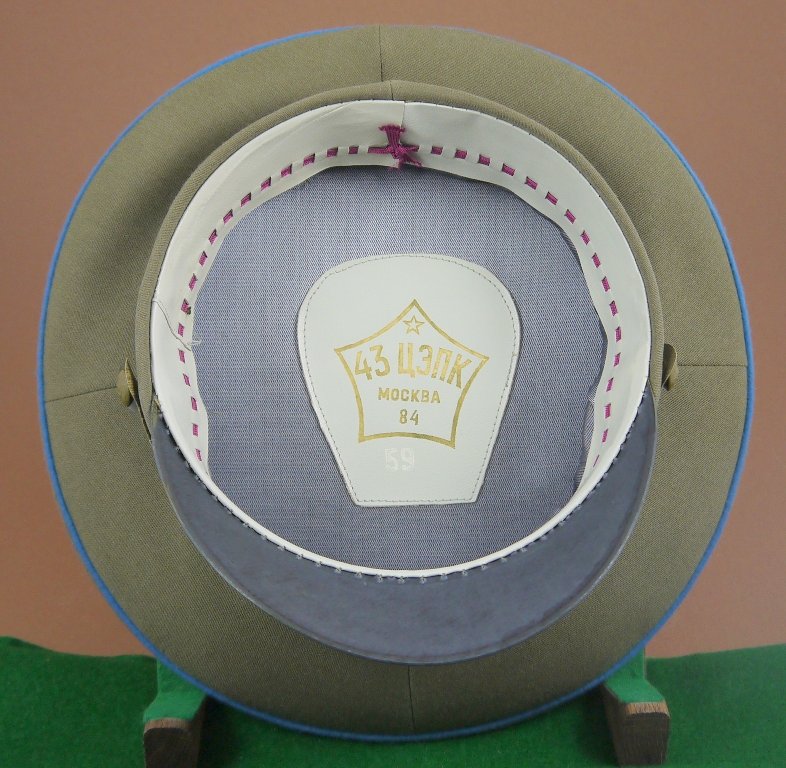
|
 Air Force
 General Parade-Walking Out
1969-1979
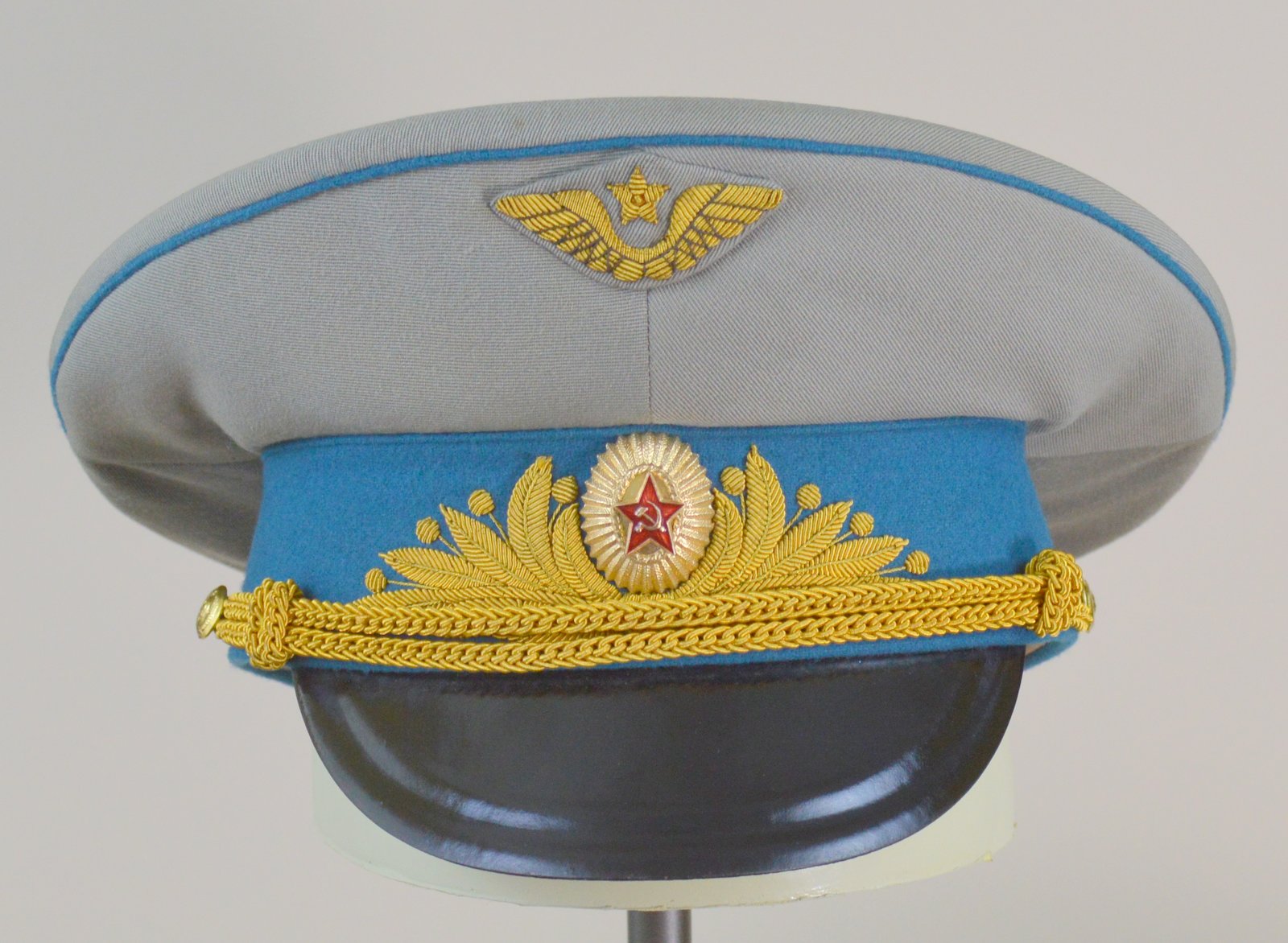
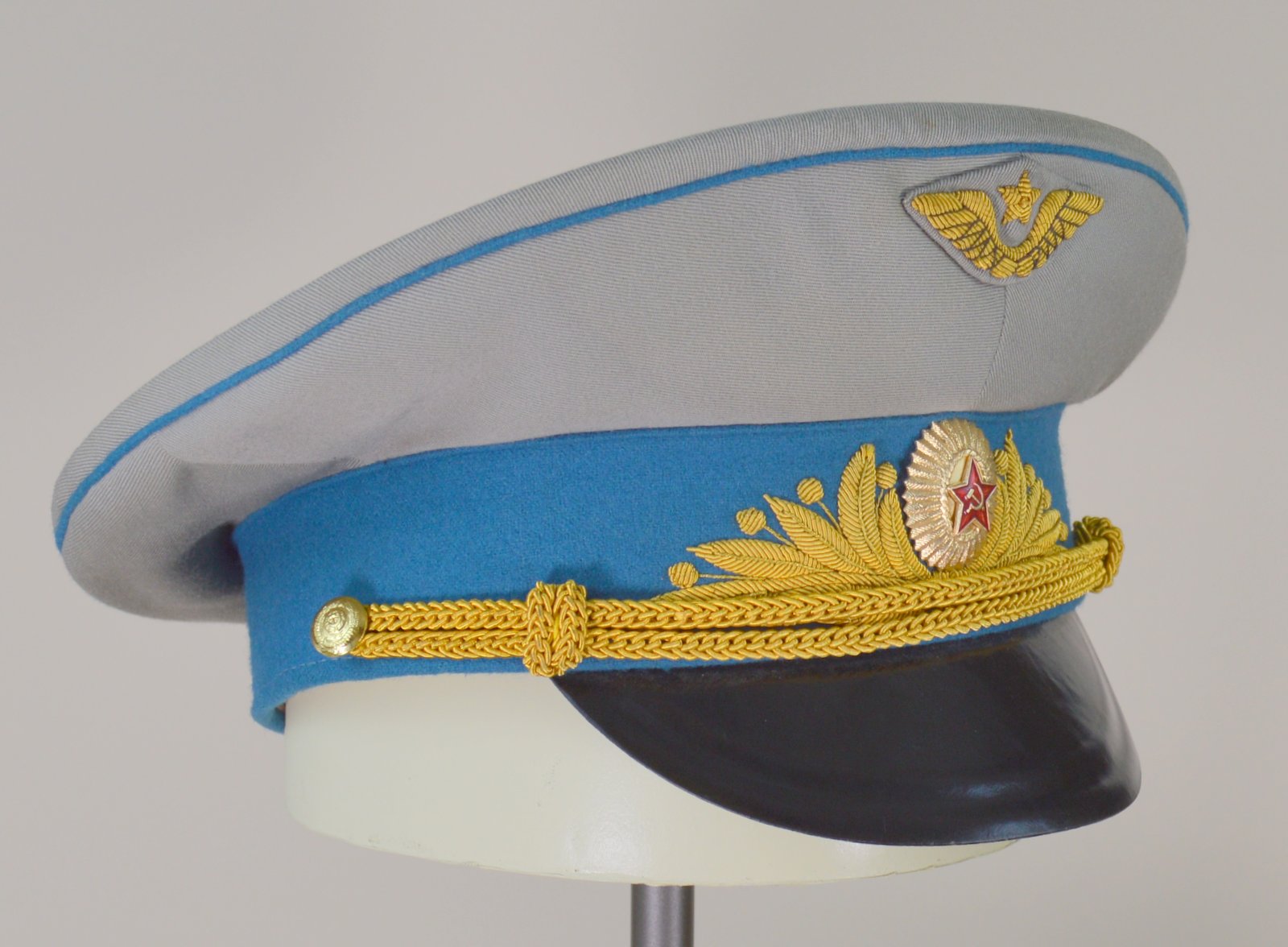
This 1970-dated cap illustrates the expanded band embroidery authorized for general-officer parade-walking out dress in 1969.
Like its 1955 counterpart discussed earlier, the crown is sewn from
fine light gray gabardine cloth suitable for summer wear. Band and piping of course remain azure. Cords, buttons and M55 cockade are standard and the visor is black fiberboard.
The laurel leaf band embroidery is unique to this style cap, with seven leaves on each side of the cockade (contrast this with the band pattern found on the 1980 service cap discussed next!). While the stylized laurel leaves
are embroidered directly onto the band, the wings are separately embroidered onto gray material and then sewn onto the crown.
Rare
 Air Force
General Service
1980-1991
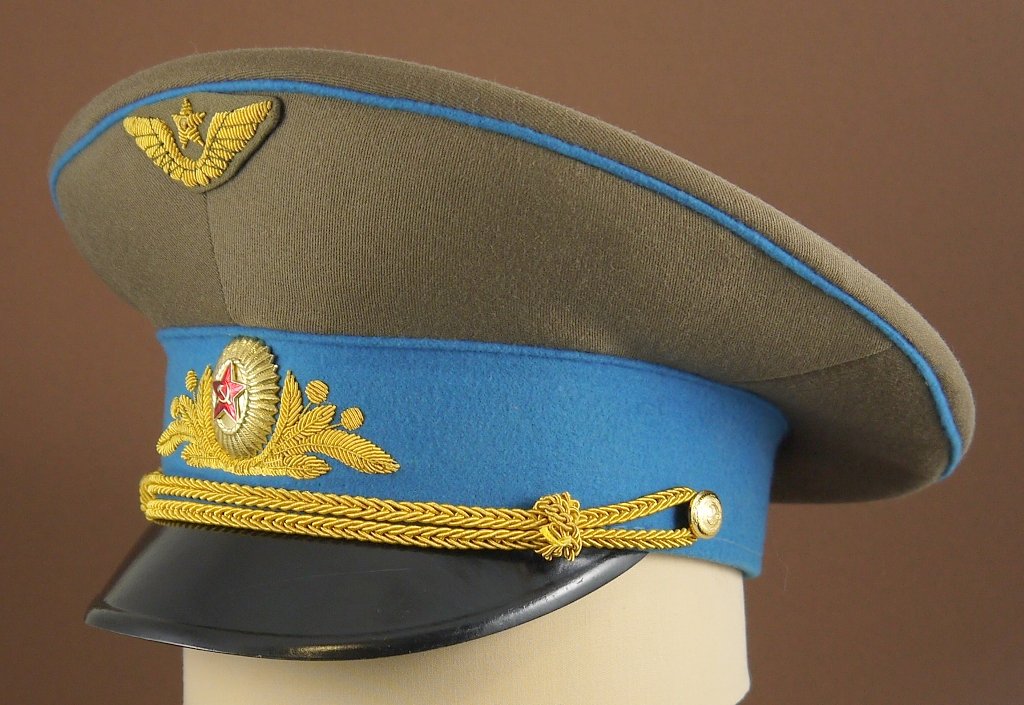
This 1981-dated cap displays the expanded band embroidery authorized for generals/air marshals' everyday caps in 1980 following the abolition of the gray walking-out
cap. The embroidery took the shape of stylized laurel leaves; four on each side of the M55 cockade. This new decoration is embroidered directly onto the azure wool used for the band - not on a separate piece of fabric as was common earlier.
The wings, however, are sewn onto a separate backing before being attached to the crown. Plastic generals' buttons hold the gold filigree cords in place over a black-lacquered fiberboard visor.
Later versions of this cap commonly had the fiber visor replaced with shiny simulated leather.
Available
 Air Force
General Tan Service
1981-1991
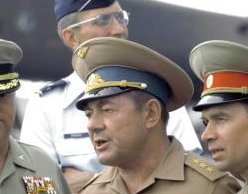
Designed to complement the tan hot-weather uniform developed in the early 1980's, this type cap first came to wide Western attention during MSU Akhromeyev's visit to the U.S. in 1988. During that visit, all Soviet Army and Air Force personnel wore versions of this cap. Air Force caps were banded and piped in light blue, while Army personnel wore red banded caps.
In the last few years of the Soviet Union, these caps were also increasingly seen during Soviet military visits and postings to Africa, Cuba and the Middle East. The major difference between this cap and the normal Air Force service cap is of course the color and fabric used for the crown - a light tan, cotton material. The crown is actually a removable cover, supported by a white padded framework as seen on most Naval officer summer caps.
The inside of these caps was also "tropicalized", with a lightweight white lining. The band embroidery mirrors that found on the post-1980 service cap, with 4 stylized laurel leaves on either side of the M55 general's cockade.
Very Rare

 Air Force
Flying Officer Service/Parade
WWII-1947
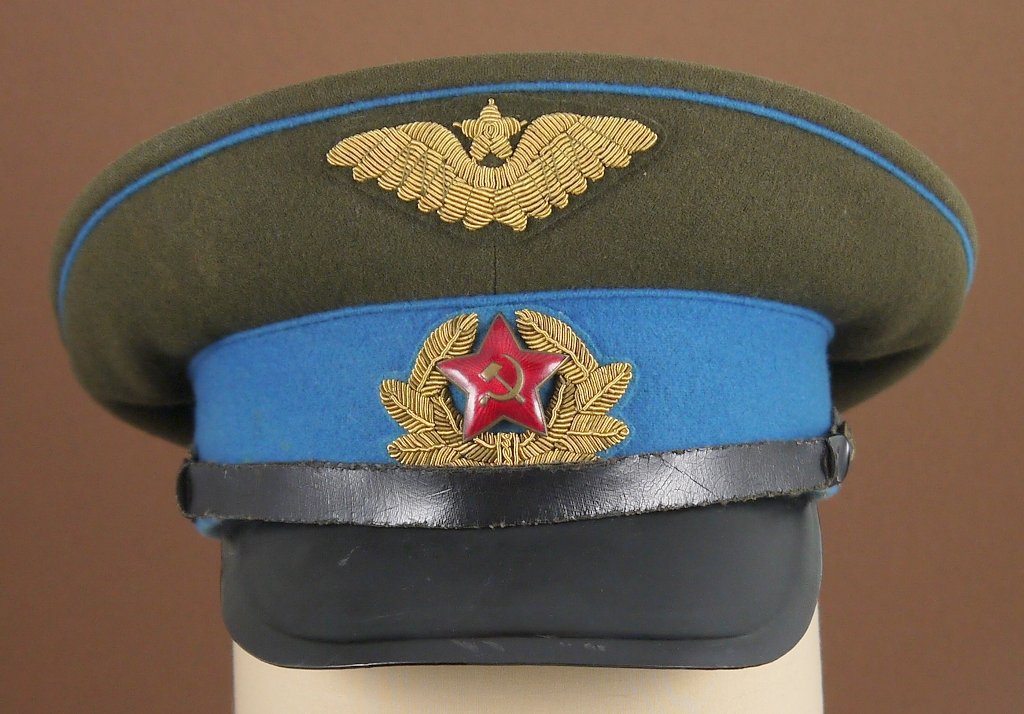
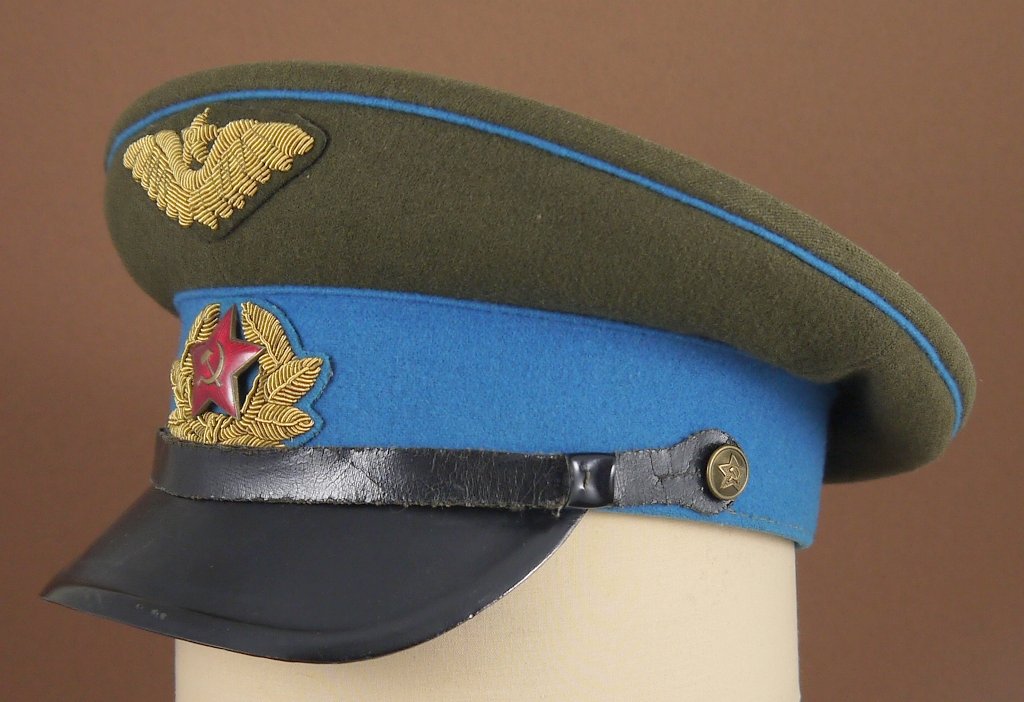
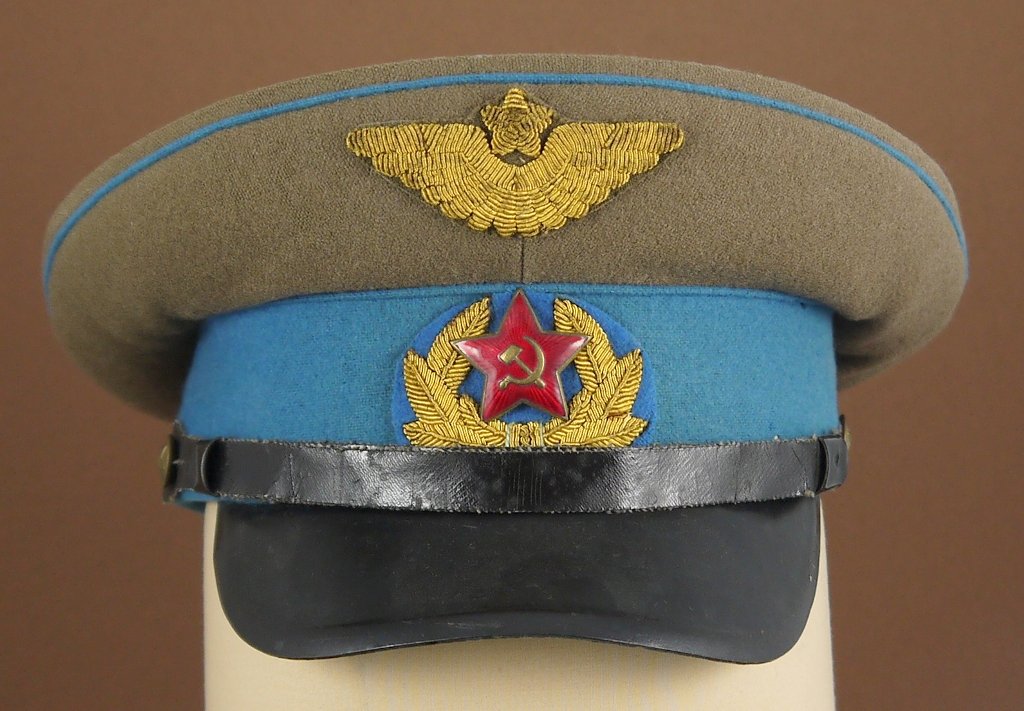
Shown here are two examples of similar caps worn by Soviet flying officers in World War II and until 1947. They are both made of napped khaki wool (two different shades) with azure
bands and piping. They also have Model 1935 spade-shaped visors and oilcloth chinstraps.
But of course the stand-out element is the gilt wire embroidery on the crown and band which was only worn by flying personnel. Non-flying personnel made due with a plain red star like the Army. The wings on the crown are embroidered onto matching khaki wool and then sewn onto the crown.
The wreaths were also embroidered onto wool backing that was then sewn onto the crown. A standard M39 brass-coated steel and enamel star was then pinned in the center of the wreath. This cockade arrangement was one of two types commonly seen in pictures of WWII pilots - the other having a circular rim behind a smaller version of the star (shown to the far right).
Although the style of this cap essentially remained unchanged until 1969 (small crown only a little larger in circumference than the band), the wreath and star combination changed in 1947 when a round gilt metal and enamel cockade replaced the red star on officers' caps.
Scarce
 Air Force
Sergeant/Kursant/Non-Flying Officer Service/Parade
WWII-1954
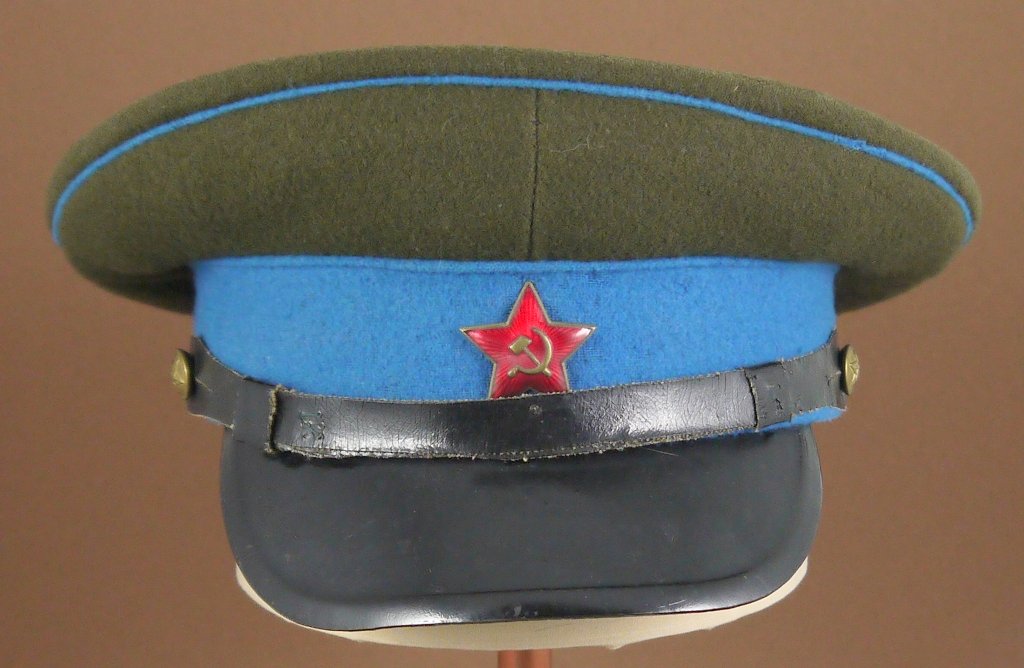
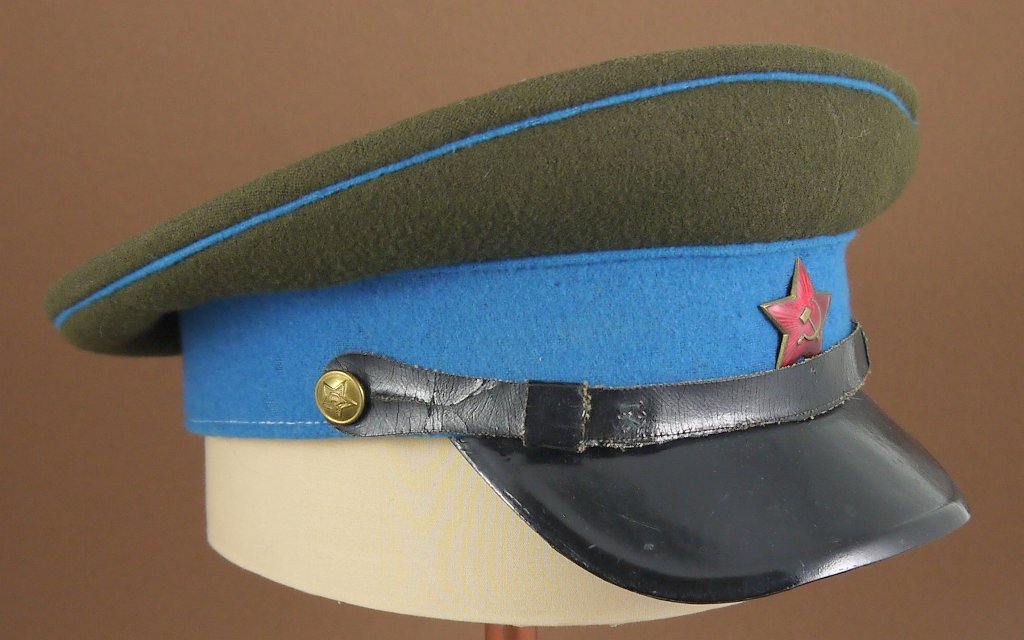
This is the non-flying counterpart to the above cap - worn by NCOs and officers not serving as pilots or flight crews. Regardless of the wearer's rank, this style remained in use until the spade-shaped visors were replaced with semi-circular ones in 1954 and new officer cockades were introduced in 1955. In all but ornamentation this cap mirrors the caps above. It has a dark khaki napped wool crown, azure wool band and piping, oilcloth chinstrap and brass buttons. However, it lacks the embroidered wings on the crown and the wreath on the band - both of which were reserved for flying personnel until 1957.
While service and parade caps of these personnel were identical through 1948, 1949 regulations did add visor ornamentation to officer parade caps (see below for more information).
Scarce
|
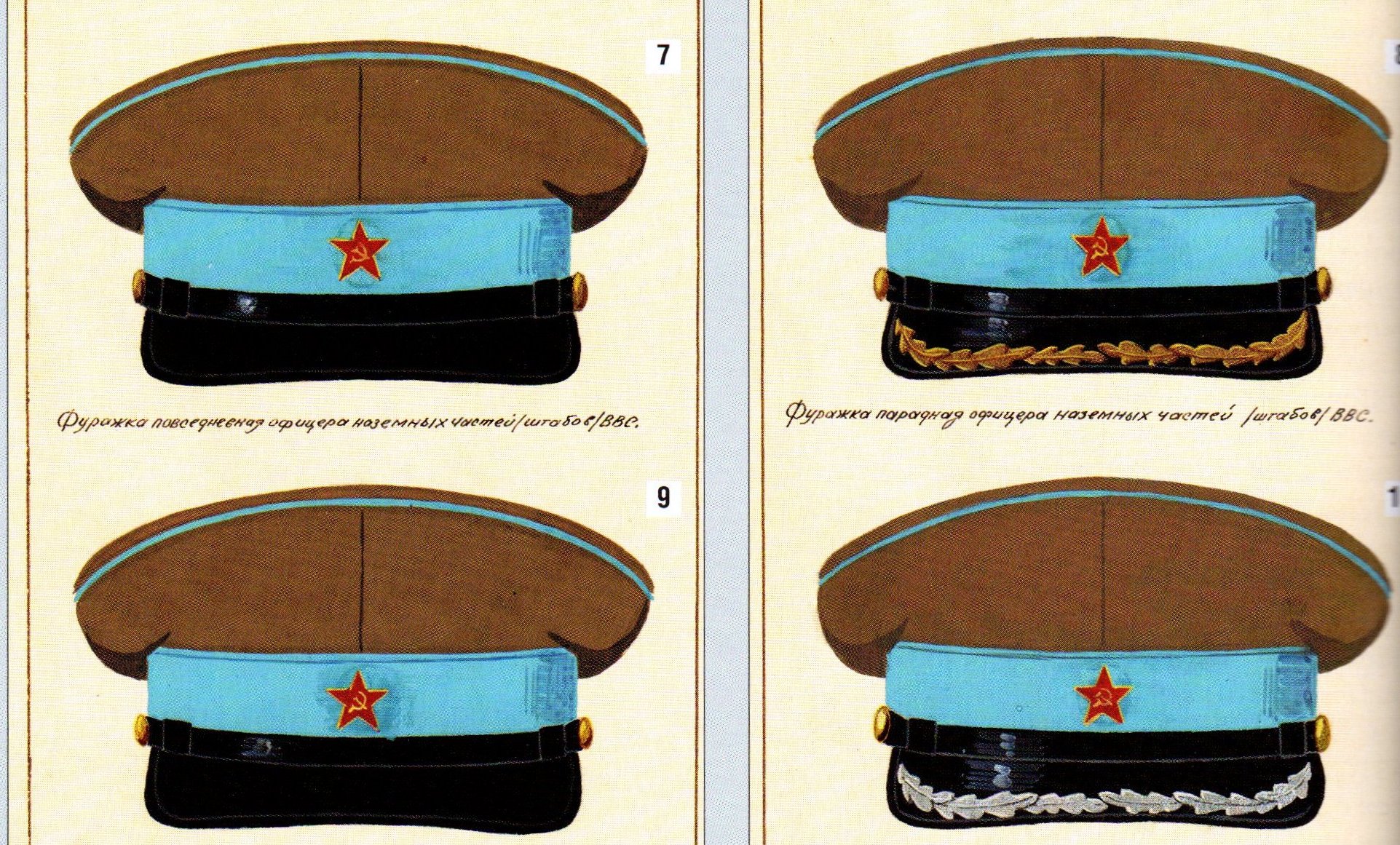
Shown here are illustrations of 1949 regulations concerning caps worn by non-flying Air Force officers from the book: "Uniforms of Russian Military Air Fleet; Tom II, Chast 1, 1935-1955." Service caps are to the left and parade caps are to the right. The top row shows ground service and staff officers while the bottom row (with the silver visor leaves on the parade cap) shows engineering officers. Again notice the plain red star of non-flying officers vice the wreath and wings used by flight officers. Buttons are gilt, even for engineering officers (unlike in the Navy). |
 Air Force
Flying Officer Parade
1949-1954
A new parade cap design appeared in 1949 for Air Force flight officers: incorporating a new metal cockade and wings combination and with metal visor decoration.
These elements are clearly shown here on a cap from the collection of Phil Mironov. The napped wool crown is olive green while band and piping remains azure blue.
The M49 cockade is a two part construction, both stamped from brass and clipped together in back. The center rosette is identical to that introduced in 1947. The wings are now also stamped
brass, replacing the embroidered wings used previously by flight officers. Early versions of this piece were constructed from two pieces, with the star stamped separately and soldered onto the back of the wings.
The visor is spade-shaped fiberboard; now with a set of stamped brass "oak" leaves pinned to it. A black oilcloth chinstrap remained standard for all officers even on parade caps during this period.
Rare
 Air Force
Flying Officer Parade (transitional)
1954
This cap is apparently a short-lived transition model of the cap just discussed, incorporating the new semi-circular visor introduced in 1954 and a style of metal visor leaves used earlier on Naval officer caps (probably as a stop-gap until the new M55 visor leaves became available).
The dark blue M1955 cap discussed next replaced this cap for dress/parade purposes the following year.
Rare
 Air Force
Flying Officer Parade
1955-1957
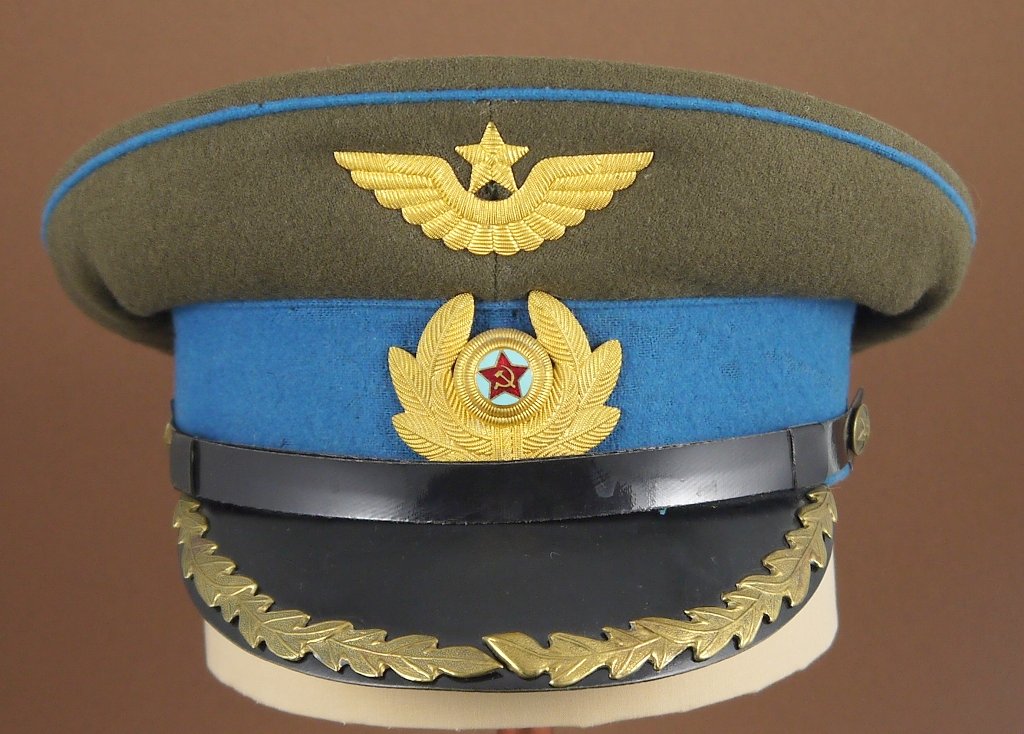
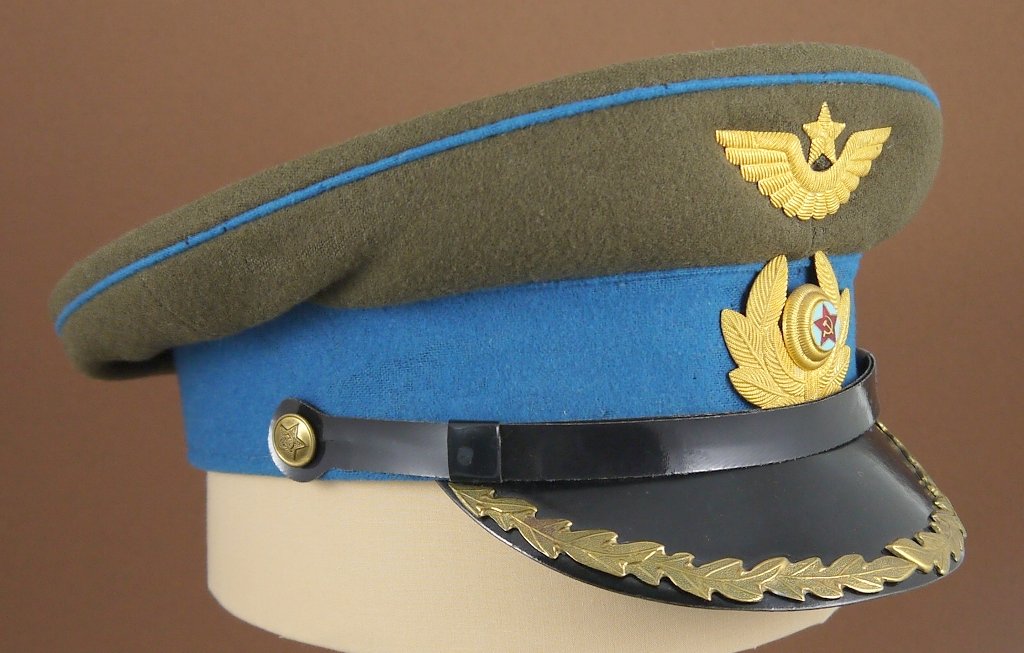
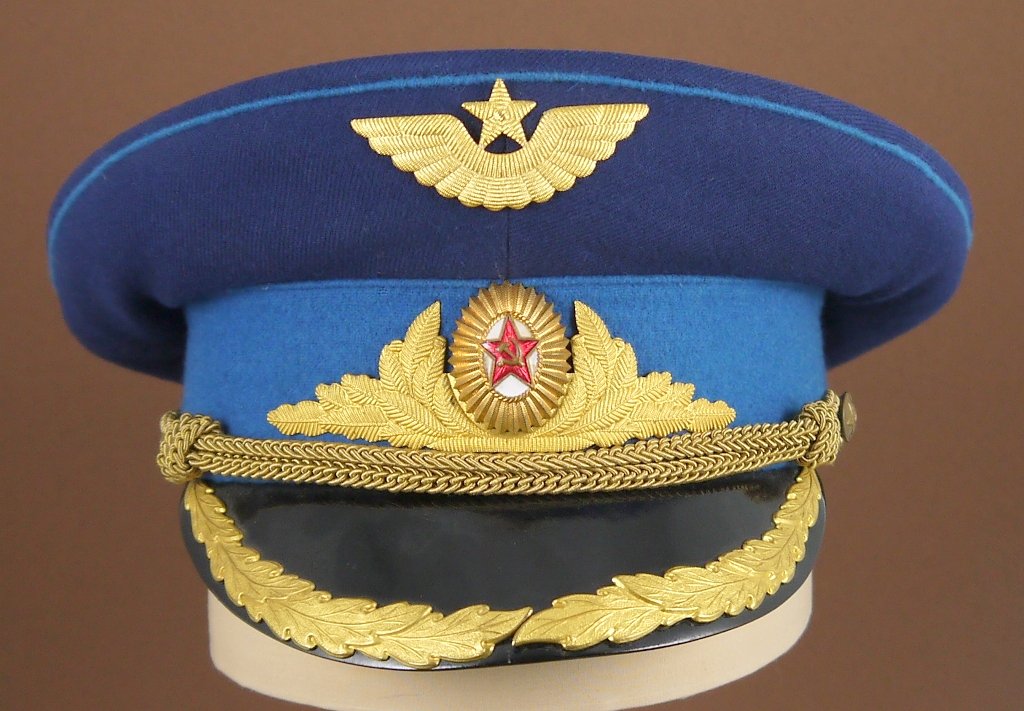
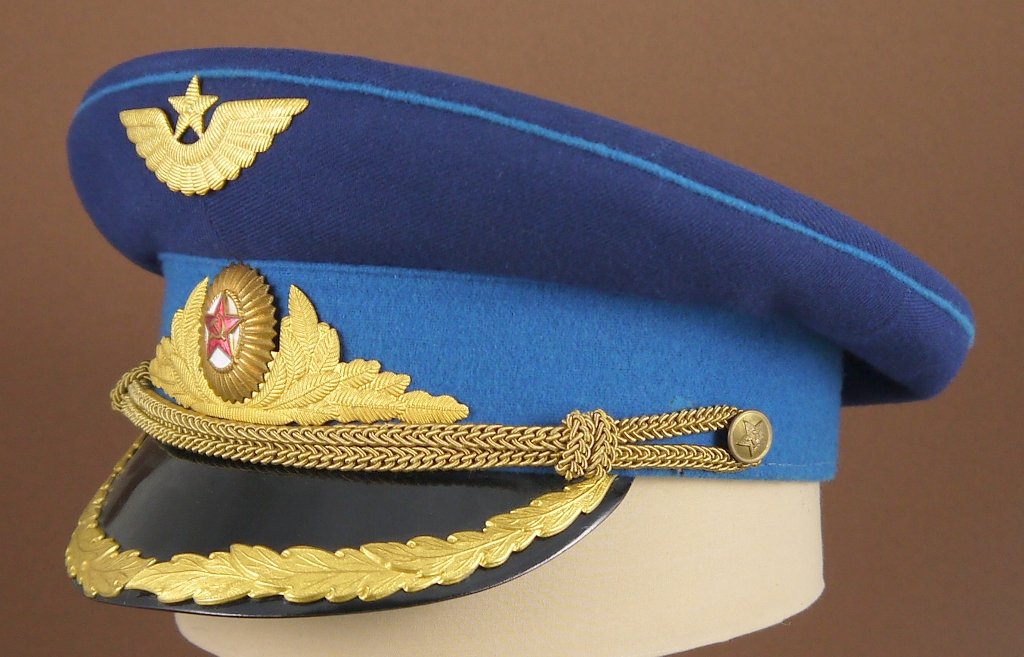
The next two caps show variants of the M55 officer parade uniform cap in napped dark blue wool with azure band and piping. This uniform was the Air Force counterpart to the gray-jacket parade uniform introduced for the Army that same year. Both the gray and the dark blue uniforms are often referred to by collectors as "Zhukov," apparently since Marshal of the Soviet Union Zhukov was Minister of Defense over the same period these uniforms were in use - 1955-1957.
In actuality, MSU Zhukov reportedly disliked these uniforms and moved very quickly to have a new one designed - the model-1957 uniform. That model was never adopted, however, due to Zhukov's ouster that same year.
Other than the color and the wings on the crown, the M1955 Air Force cap was exactly the same as the Army gray version. It has the new tombac officer's cockade pinned through a thin sheet-metal brass wreath and mounts brass or aluminum leaves pinned through the fiberboard visor. These leaves were of a new design - different and more elegant than the type previously used by the Navy or authorized for Air Force and Armor officers in the 1949 regulations. The M55 leaves were to become standard for all services until the fall of the USSR.
Gold dress cords were now authorized. As previously mentioned - this cap also has stamped metal wings pinned through the dark blue napped wool crown indicating the wearer was a pilot or member of a flight crew.
Scarce
 Air Force
Non-flying Officer Parade
1955-1957
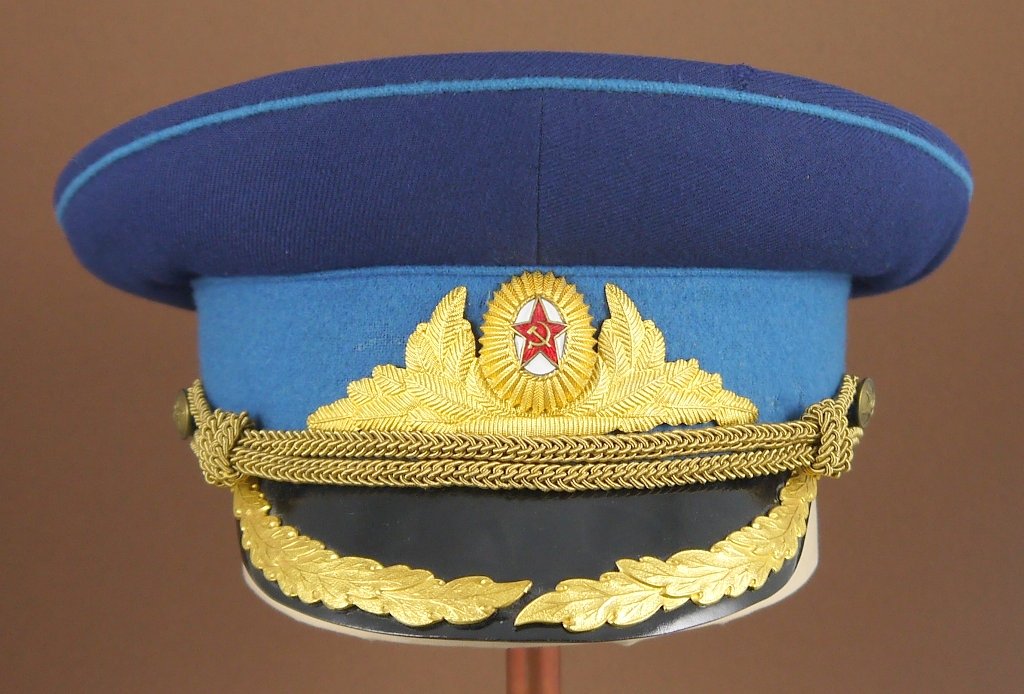
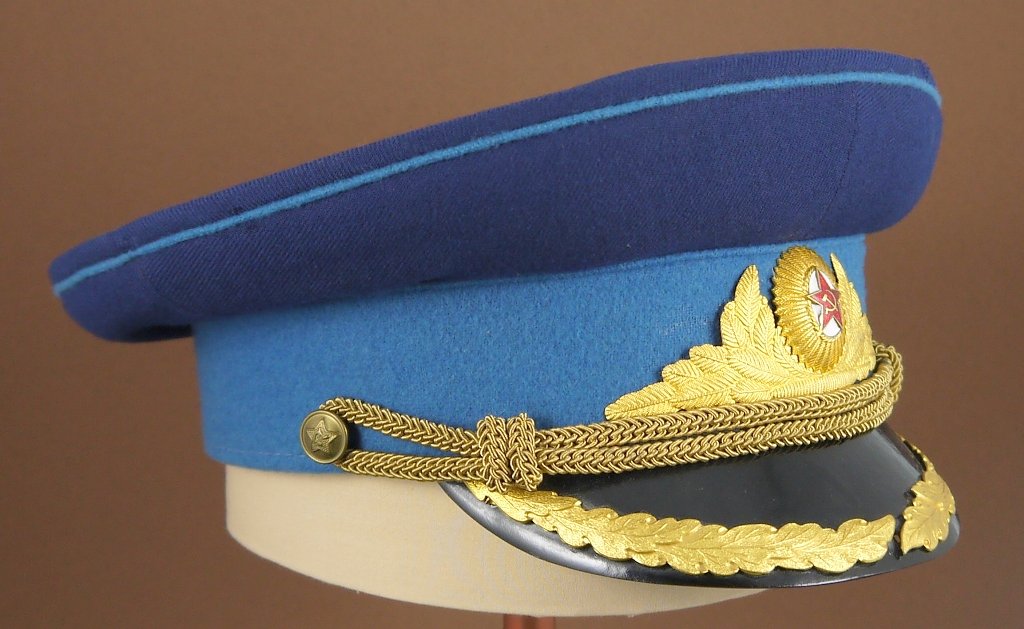
Identical to the cap just described, this 1956-dated cap differs only in the lack of wings. This signifies the wearer was a non-flying Air Force officer - such as one working in maintenance, logistics, air traffic control, etc.
Authentic non-flying officer parade caps are actually rarer than the ones with wings. Although you could convert a non-flying cap to flying (by adding the wings) - you cannot convert a flying to non-flying due to the hole left by those same wings.
Rare
 Air Force
Officer Service
1955-1968
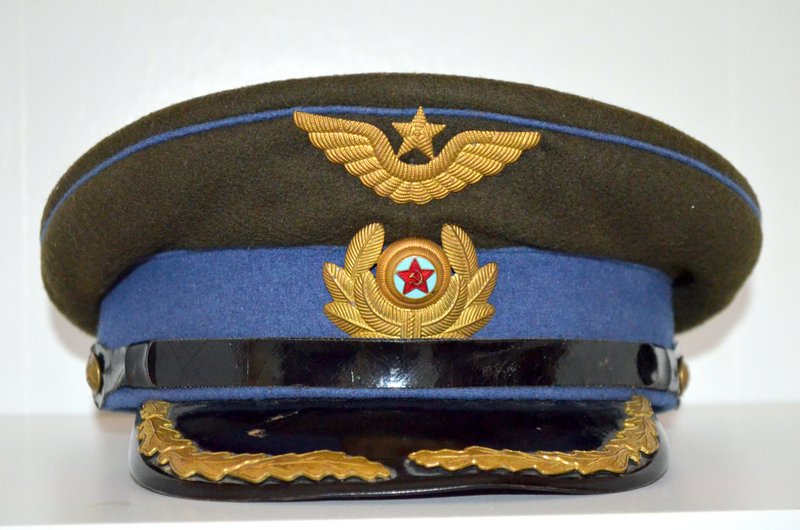
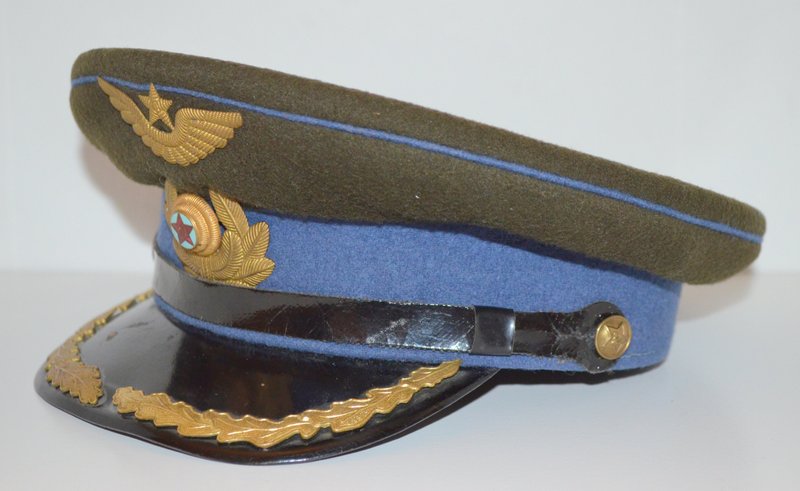
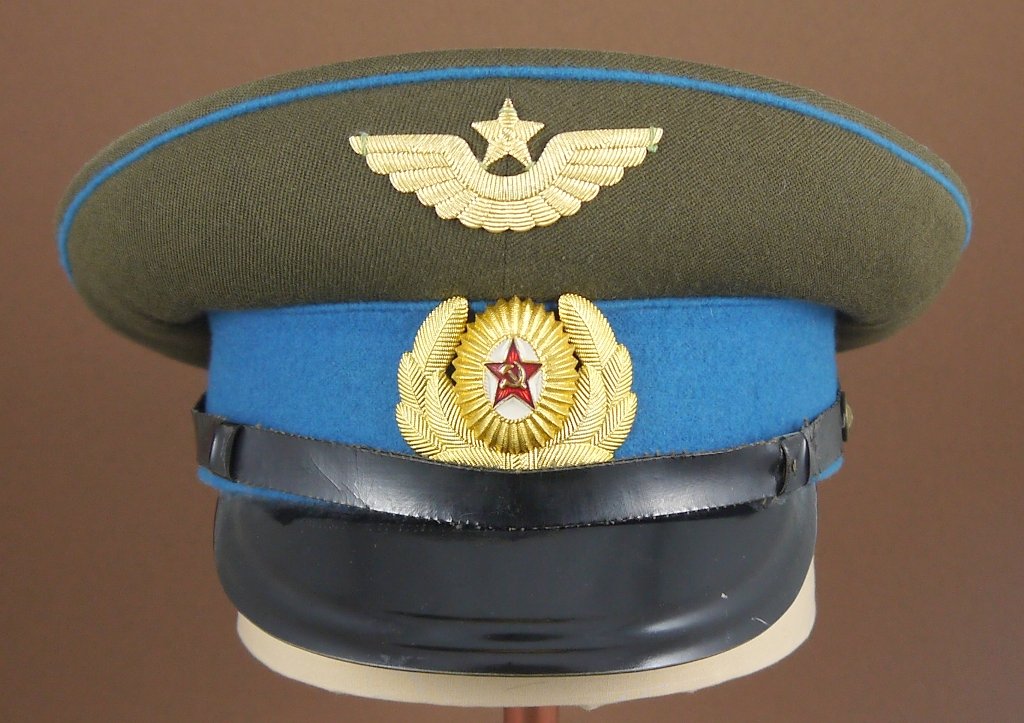
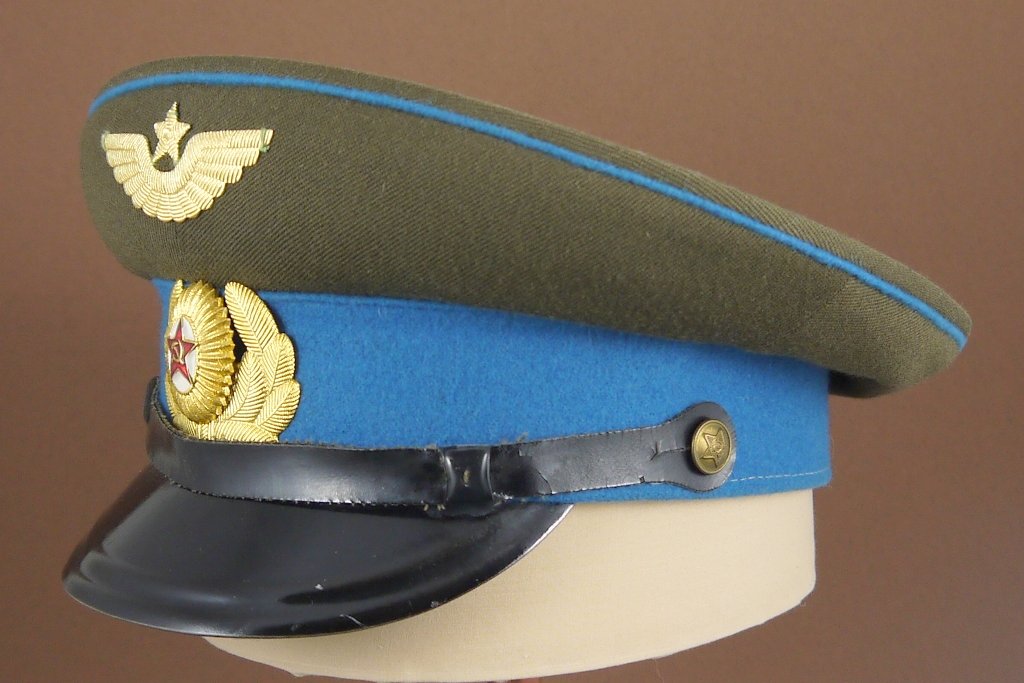
Appearing little changed from Air Force service caps worn since WWII and popularized in the West by Cosmonaut Gagarin; this khaki cap retains the traditional light blue band and piping of aviation. It displays the then-new M55 oval officer's cockade pinned onto a separate brass or aluminum wreath. Later this cockade/emblem was simplified into a single aluminum piece.
The stamped metal Air Force wings are rather unusually sewn onto the crown (the owner of this cap removed the clasp in back and instead had the wings attached by thread). Prior to 1957, these wings were only authorized for wear by flying personnel, but were worn by all Air Force officers after that date. The black chinstrap on officer service caps and the relatively small (or "teller") crown are standard for the period.
The visor is black lacquered fiberboard.
Airborne officers would have worn an identical cap with their service uniform after 1963, when the Airborne Troops became part of the Air Force.
Scarce
 Air Force
Officer/Extended Serviceman Parade-Walking Out
1958-1968
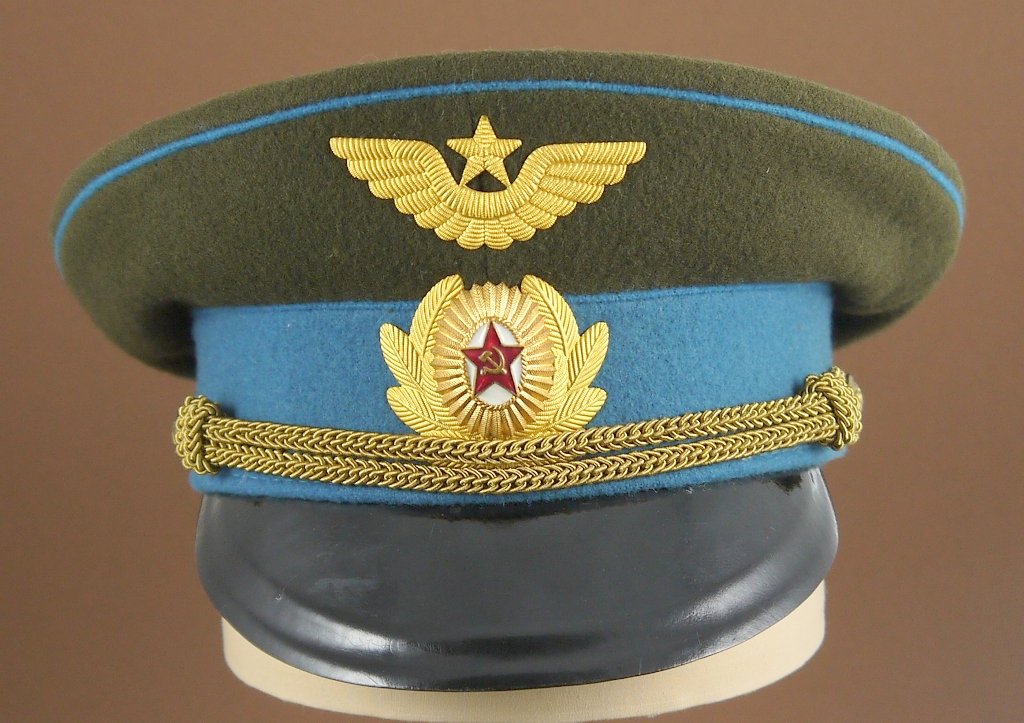
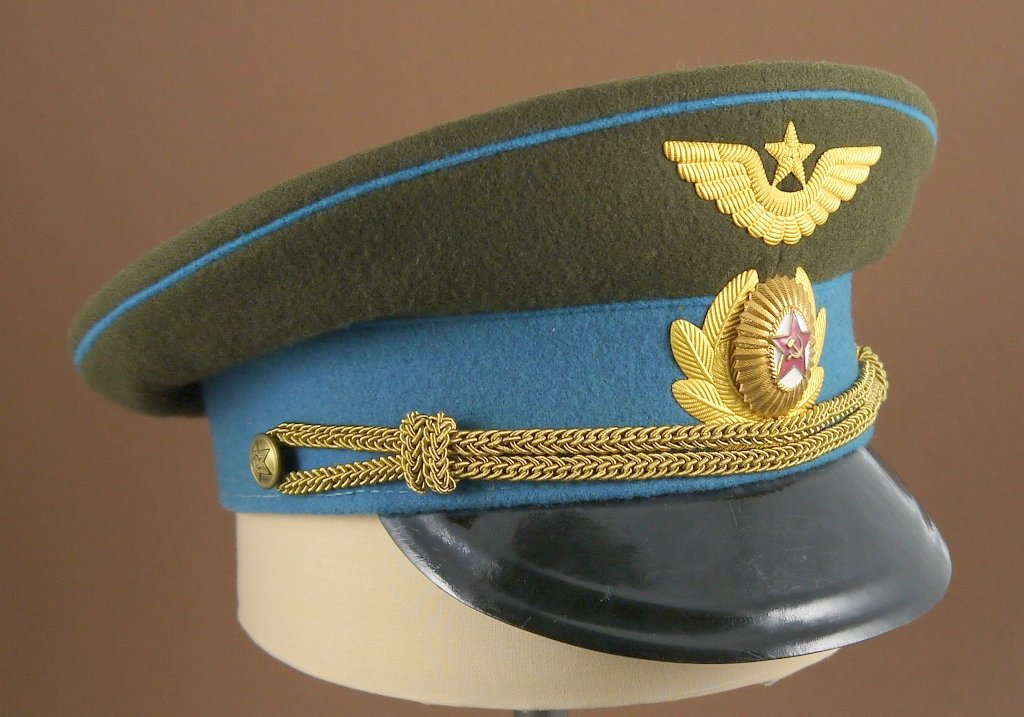
After the dark blue parade uniform was abolished in 1958, the Ministry of Defense adopted khaki parade uniforms - to which this cap belongs. It is identical to the service cap of the period, but with the black strap replaced with gold cords.
This 1956-dated cap was actually a hold-over from the 1955-1957 period during which it served as part of a service uniform. Even without the date mark, the dark khaki napped wool crown would have dated it prior to 1958.
The two-piece emblem is also an older variant - with the cockade being heavy tombac (vice aluminum) and the wreath is stamped brass vice aluminum. As expected, the visor is black painted fiberboard and buttons are brass. As previously mentioned,
after 1957 the wings on the crown were standard to all officers - not just flying officers. This same cap could also have been worn by an extended serviceman with his parade uniform.
Scarce
 Air Force
Soldier/Sergeant/Kursant Parade-Walking Out
1955-1968
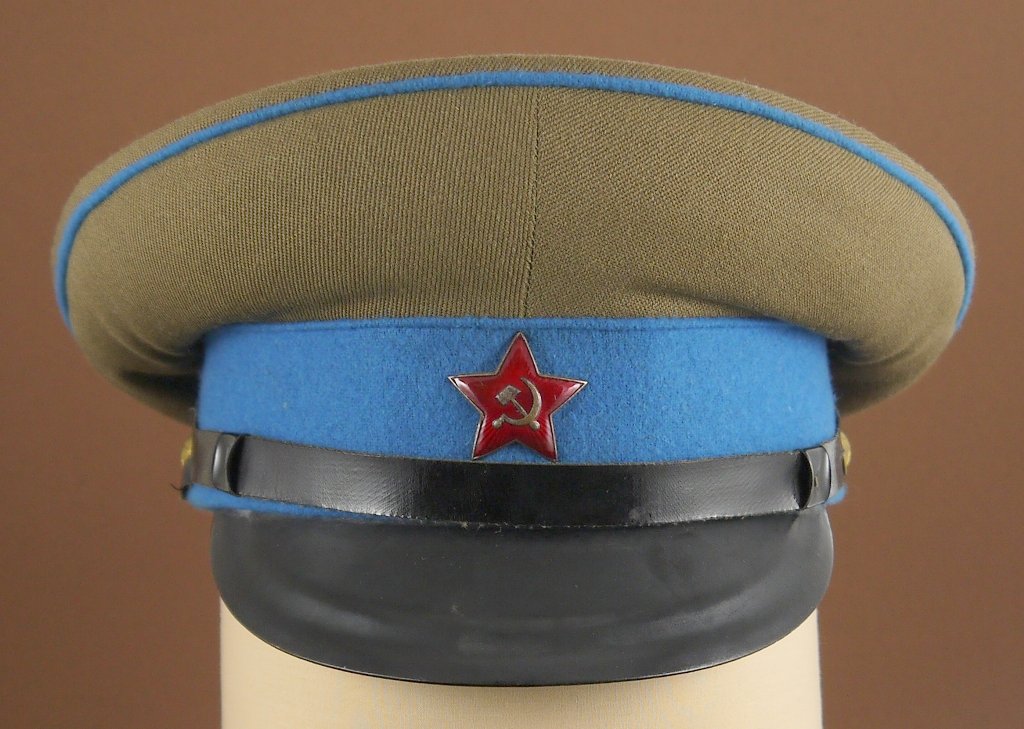
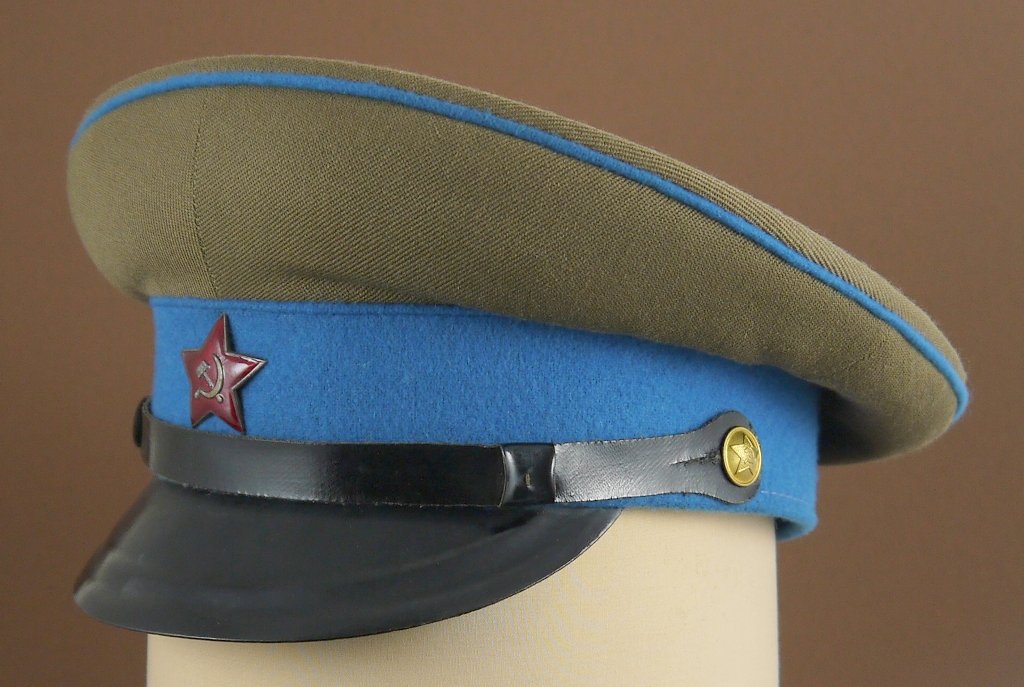
A conscript soldier (regardless of rank) or a cadet at an Air Force commissioning academy (Kursant) would have worn this as part of his parade-walking out uniform.
This 1967-dated cap has the semi-circular fiberboard visor authorized in 1954 and the crown is sewn from a khaki wool blend fabric, vice the napped wool of the earlier caps.
The rest of the cap is standard for the time - black oilcloth strap, brass buttons, enamel and brass-coated steel red star. Again - notice the smaller crown characterizing all caps until the larger model 1969 was introduced.
An extended serviceman (a sergeant enlisting for additional service after completing his conscript requirements) would also have worn this cap with his service uniform after 1957.
Scarce
 Air Force
Officer/Warrant Officer/Extended Serviceman Parade-Walking Out
1969-1991
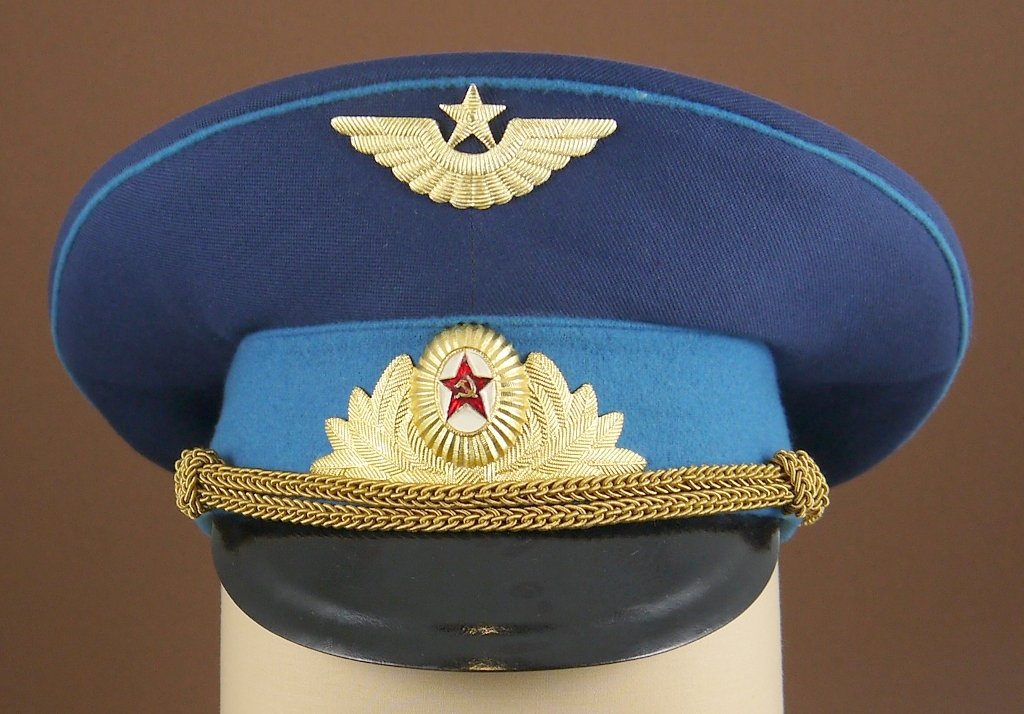
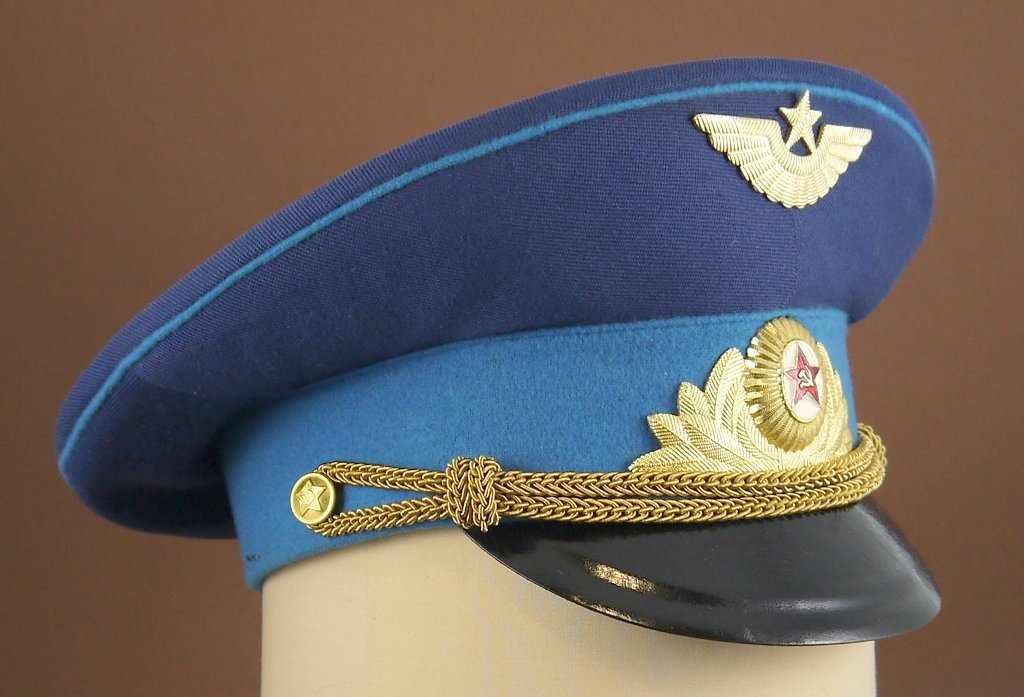
One of the major aspects of the 1969 uniform regulations was the creation of brand new parade walking-out uniforms for all Army and Air Force officers, warrant officers and extended servicemen. Air Force officers
regained their traditional dark blue - which they had first worn in the 1930s and then again in 1955-1957. The 1971-dated cap shown here was one of the first of the M1969 models -
and consequently has a two-rimmed black fiber visor and metal buttons (plastic later replaced both of those). Besides its color, the main distinguishing feature of this cap is
the new parade cockade introduced specifically for this and the wave-green Army officers' parade cap. It somewhat resembles the wreath used on the M55 parade cap, but
is not as well made and is a one-piece aluminum casting with white and red paint. Warrant officers wore this same cap after that rank was authorized in 1972.
Common
 Air Force
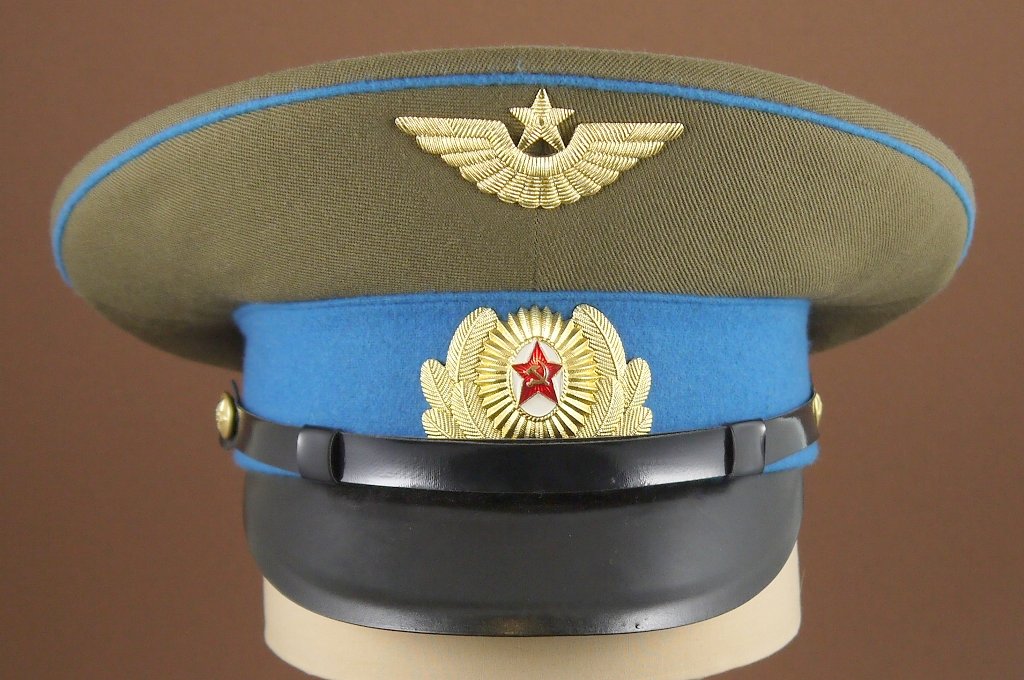
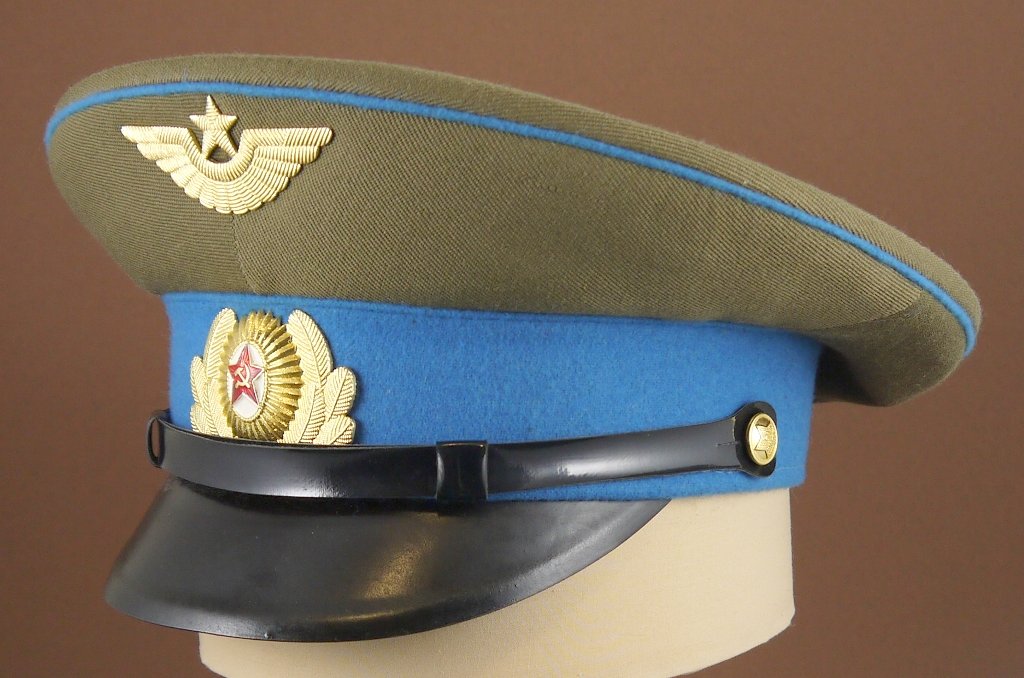
Officer/Warrant Officer/Extended Serviceman Service
1969-1991
A very versatile design, variations of this cap had been around since 1955 (as shown above) and at one time or another was worn by officers, warrant officers and extended servicemen. This is the M69 model with the larger crown.
The key feature in this case is the black chinstrap. Officers wore this cap up to 1975 when they were authorized to wear gold cords instead of the strap. Warrant officers (first created in 1972) wore this style
from then on and extended servicemen wore it throughout the entire 1969-1991 period with their service uniform. This particular cap is dated 1980 and still has a single-rimmed black fiberboard visor. Both emblems are aluminum and the cockade is one-piece.
Common
 Air Force
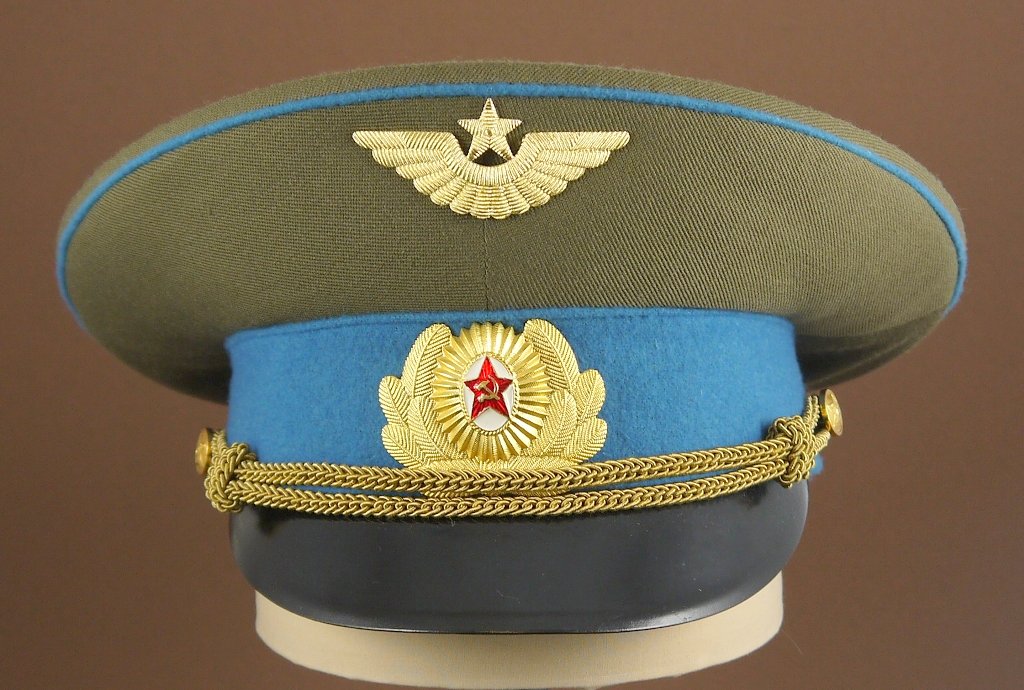
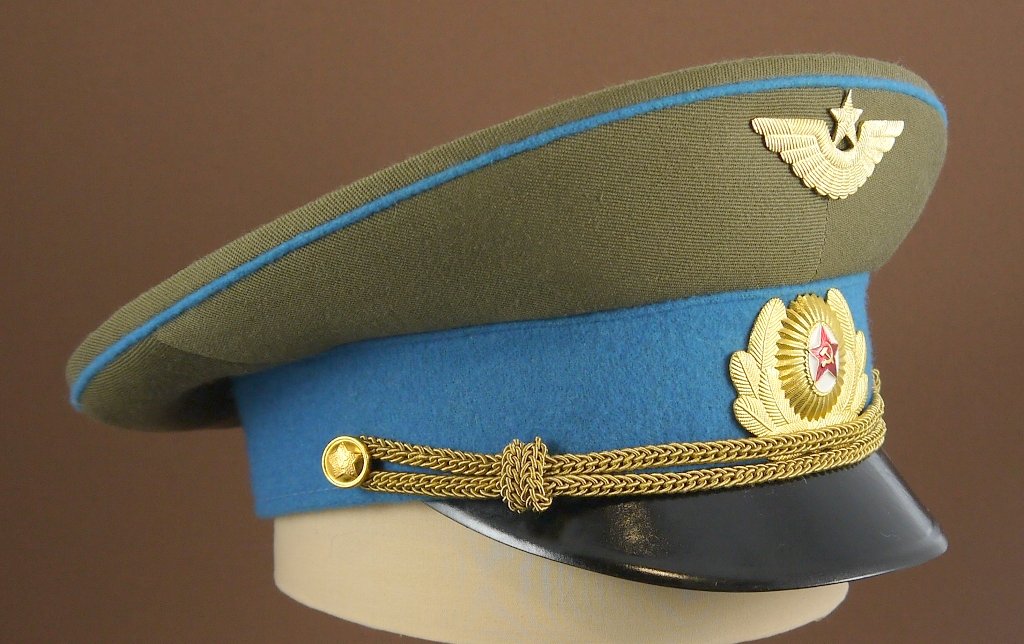
Officer Service
1975-1991
This cap differs from the one just described only in the substitution of gold filigree cords for the black chinstrap. This occurred by regulation in 1975 for officer service caps.
Dated 1984, this cap was one of the last to have a black-lacquered fiberboard visor. Plastic ones became standard after 1985 although both types were used interchangably from the late 1970s.
Common
 Air Force
Conscript/Kursant Parade-Walking Out
1969-1991
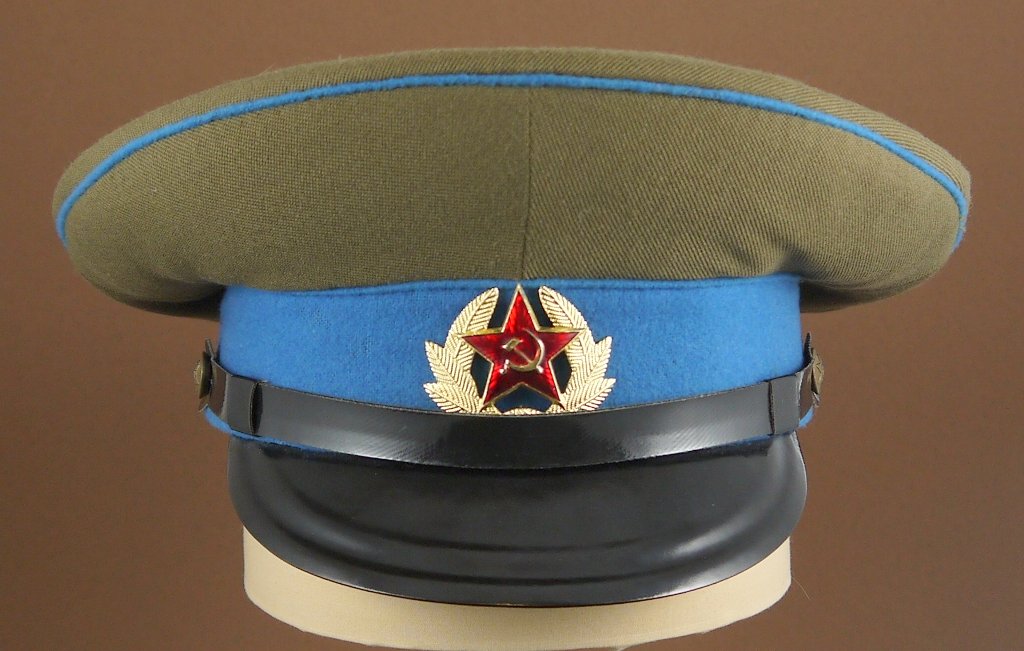
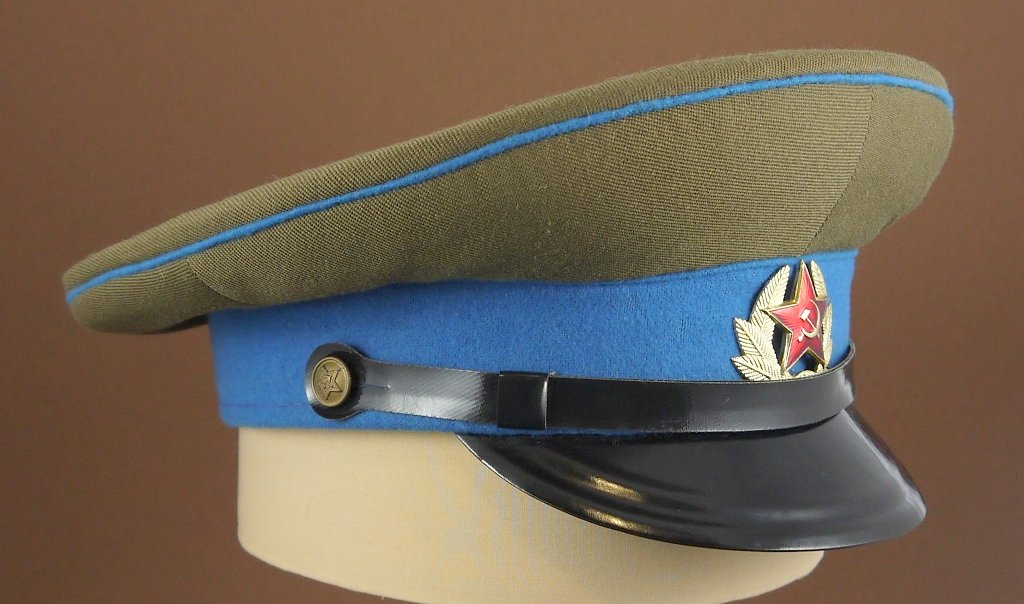
Conscripts and cadets at Air Force commissioning schools would have worn this cap as part of their parade/walking out uniform. It is a standard Air Force cap but with the addition
of the conscript dress emblem (star in wreath) authorized in 1969. Unlike officers, conscripts did not wear wings on the crown; nor did Kursants until this privilege was granted them in 1987.
This particular cap was produced in 1970, so is one of the first of the M69 design. Consequently it has the two-rim style fiberboard visor. The emblem is one-piece but at this early date could have also
been the two-piece version (see my Army 1969-1991 page for more information and pictures of this early badge).
Common