
 Fakes and Replicas
The Threat Posed...
When I first started this site in 2003, I indicated fakes were not a major concern for Soviet uniform/cap collectors. This was true at the time, since there was a major "glut" of authentic caps entering the market. But since then, a major fake/replica industry has developed. When fakes first showed up - they were usually high-end types, general and admiral caps made with authentic materials left over from the collapse of the USSR, which were rarely encountered by the casual collector. The next wave of reproductions were just that - reproductions intended primarily for the military re-enactors, especially for WWII. Now, however, a large percentage of Soviet caps offered for sale on auction sites and on Soviet militaria websites are fake. Many of these modern fakes are coming out of Ukraine although others now originate from Pakistan. Interestingly enough, the quality of most current replica general and admiral caps has deteriorated (with silk embroidery vice metal wire embroidery), while fake Soviet officer and soldier caps are often very well made with materials very close to the originals. So be VERY CAREFUL when buying a cap that looks new. Ask me if you have any doubts before buying something you're unsure of. I am always happy to help. In the following paragraphs I have attempted to discuss these different categories of "fake" caps, why they exist and what to look for in "suspect" caps.
General/Admiral/Marshal Caps
There are two types of fake general, admiral, and marshal caps out there. 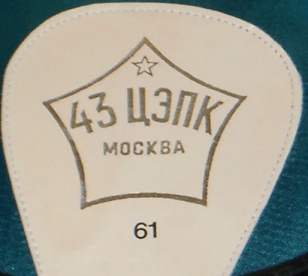 There are still some of the higher end types (all out of Ukraine) which have wire embroidery and are made EXACTLY like original pre-1991 caps.
 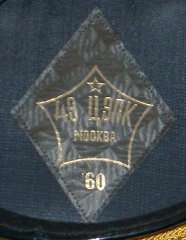 Linings are silk, visors are wool-backed kid leather, and sweat-bands are actual leather. In fact, these are so well made that it is often impossible to determine if they were manufactured just before or after 1991. While they typically have horseshoe shaped leather maker tags sewn to the lining (as in the left photo), they usually do not have year date stamps. While many would automatically discount these as fakes since they do not have year stamps, based on my surveys of markings of hundreds of Soviet caps, I can confirm this company largely stopped placing year stamps on its labels after 1988. Consequently, at least some of these caps were produced prior to 1991 for the Soviet Army and Navy. Consequently, I don't feel these caps should be excluded from collecting.
Just beware that some models that were never officially authorized - such as Border Guard or KGB general caps - were also made in the early 90s to these same high standards specifically for collectors and should be considered as "fantasy."
Ones with the black, shiny diamond-shaped label as on this cap to the right are also from the early 1990s.
Linings are silk, visors are wool-backed kid leather, and sweat-bands are actual leather. In fact, these are so well made that it is often impossible to determine if they were manufactured just before or after 1991. While they typically have horseshoe shaped leather maker tags sewn to the lining (as in the left photo), they usually do not have year date stamps. While many would automatically discount these as fakes since they do not have year stamps, based on my surveys of markings of hundreds of Soviet caps, I can confirm this company largely stopped placing year stamps on its labels after 1988. Consequently, at least some of these caps were produced prior to 1991 for the Soviet Army and Navy. Consequently, I don't feel these caps should be excluded from collecting.
Just beware that some models that were never officially authorized - such as Border Guard or KGB general caps - were also made in the early 90s to these same high standards specifically for collectors and should be considered as "fantasy."
Ones with the black, shiny diamond-shaped label as on this cap to the right are also from the early 1990s.
A second type of general/admiral fake is still being actively made both in Pakistan and in Ukraine and possibly in Belarus and China as well. 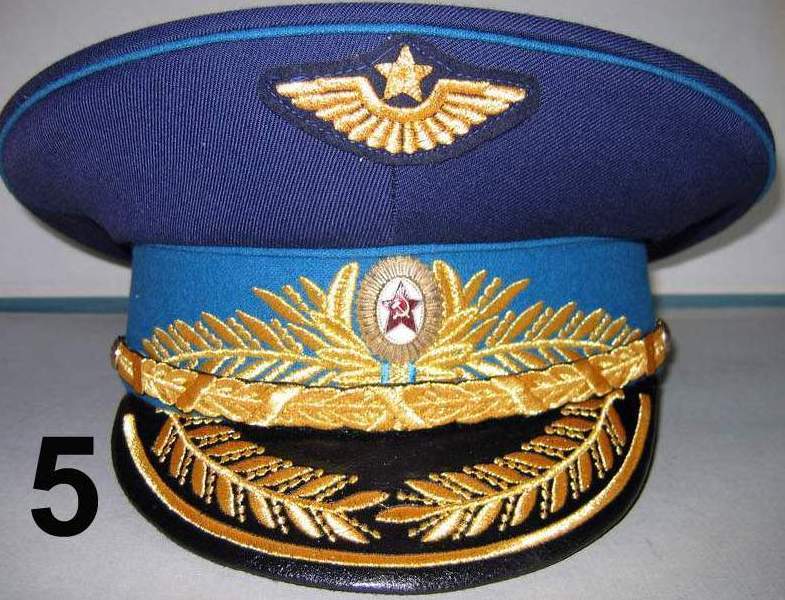 These are much more cheaply made and fortunately are easy to identify. Shown here is an "Air Force General" cap of the type. I have seen the full range of such caps - including Army, KGB and Border guard general caps as well as Admiral and Marshal of the Soviet Union.
First, the cockade is "usually" a regular officer's model, with the white enamel surround of the red star (as shown here), rather than the correct all gilt general's model. But the true defining element of these fakes is the band and visor embroidery. Notice from the closeups the "cheapness" of the thread embroidery. It uses silk or cotton thread (not metal wire as on the originals) and is yellow vice golden. Notice also the "wings" on this example. As you can see, it is crudely stitched to the crown and is on very thin, unedged cloth rather the "stand-alone", fully finished emblem used on authentic Soviet caps. It appears most sellers of these caps (such as the one shown here from www.soviet-power.com) do admit they are reproductions (although you may have to read closely) but some do show up on auction sites without such admissions.
These are much more cheaply made and fortunately are easy to identify. Shown here is an "Air Force General" cap of the type. I have seen the full range of such caps - including Army, KGB and Border guard general caps as well as Admiral and Marshal of the Soviet Union.
First, the cockade is "usually" a regular officer's model, with the white enamel surround of the red star (as shown here), rather than the correct all gilt general's model. But the true defining element of these fakes is the band and visor embroidery. Notice from the closeups the "cheapness" of the thread embroidery. It uses silk or cotton thread (not metal wire as on the originals) and is yellow vice golden. Notice also the "wings" on this example. As you can see, it is crudely stitched to the crown and is on very thin, unedged cloth rather the "stand-alone", fully finished emblem used on authentic Soviet caps. It appears most sellers of these caps (such as the one shown here from www.soviet-power.com) do admit they are reproductions (although you may have to read closely) but some do show up on auction sites without such admissions.
M55 "Zhukov" Caps
Shown here is an "Infantry Officer Parade M55" cap - in use by the Soviet military from 1955-1958 and sometimes referred to as the "Zhukov" model.
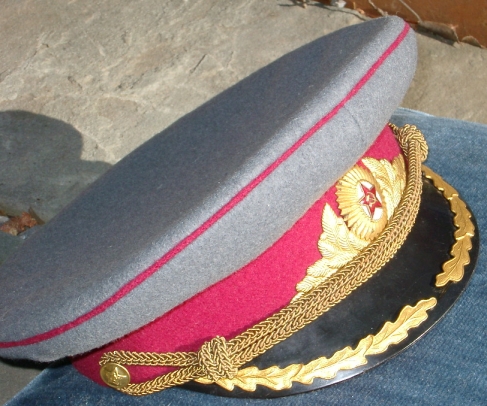
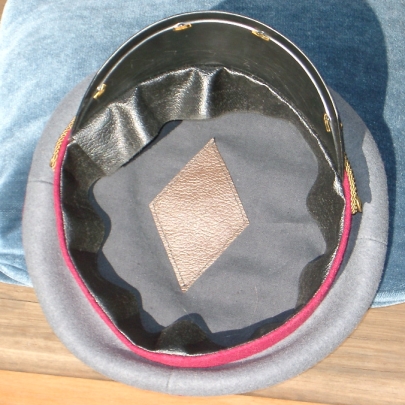 This cap is a well-made replica that uses authentic emblems on a replica body. Although not convincing to an expert "close-up", it does appear authentic in some photographs. As such - you will have to be very careful from now-on when considering purchasing one of these caps! From the picture, you can see the colors are correct (medium gray and "magenta"), and it has the correct two-piece parade cockade and gold cords. A closer examination of this particular cap will even show correct two-piece buttons of the period. However, you may notice the "odd" looking visor leaves. This contrasts to the standard style found on authentic caps. But - such a difference "could" be explained by a cap manufacturer using "whatever was on hand." Much more significant is the plastic visor! This of course is an absolute mark of a fake - since these weren't in use until the very late 1970's. The sweatband is also incorrect - being a heavy black fabric instead of the lighter gray that appears to be standard on these era caps. The interior lining is close enough to being correct - a dark gray cotton material, but the brown label is unmarked and made of the same incorrect material as the sweatband. Finally - if you find one of these caps, you will notice the wool used in the crown of the cap is very inferior to the originals. The replica wool is coarser with many apparent threads while the originals had very fine, soft wool tops with no obvious threads.
Reinactor Market
Reinactment groups in the former Soviet Union have expanded greatly over the past 10 years. Consequently, the production of officer and soldier style caps have likewise blossomed in Russia, Belarus and Ukraine. Initial replicas offered for sale in the late 1990's were rather crude and limited to just a few models - especially KGB, Border Guard and infantry. In the last couple of years, however, the variety and quality of these caps have skyrocketed, and I now believe they pose the greatest threat to the novice (and sometimes even the experienced) collector.The vast majority of these caps continue to replicate those worn by the Russian and Soviet militaries over the period 1900 to 1945. 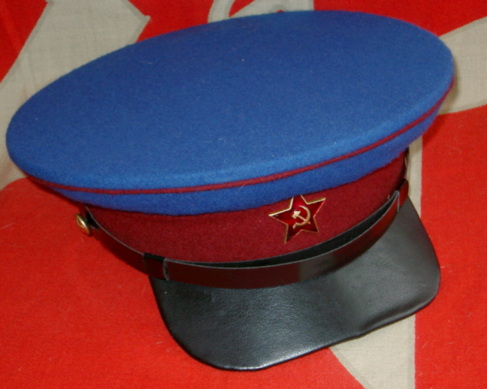 The variety of different bright-colored WWI copies is even greater - but these seem to be reliably identified as reproductions.
As mentioned above, when you found a replica WWII cap a few years ago - it was typically rather crude looking - with a modern stamped aluminum red star, plastic chinstrap, and thick leather visor.
The variety of different bright-colored WWI copies is even greater - but these seem to be reliably identified as reproductions.
As mentioned above, when you found a replica WWII cap a few years ago - it was typically rather crude looking - with a modern stamped aluminum red star, plastic chinstrap, and thick leather visor.
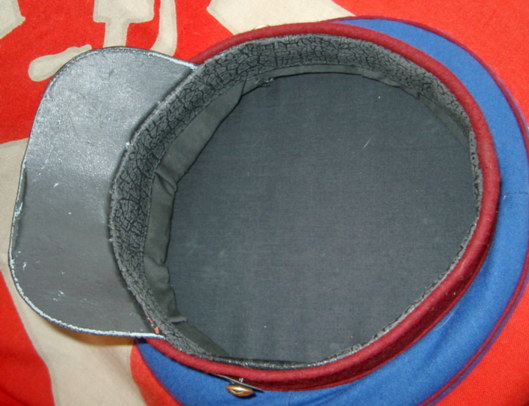
Inside linings of these first replicas were typically poorly attached and made of cheap, non-authentic materials. These were no threat to collectors. If it had a leather visor - you were 99% sure it was fake (since only a very small number of caps with replacement leather visors apparently exist). Even without that - a glance at the poorly finished interior could be counted on to identify the fakes.
However, faced with collector demands for higher quality items, clothing shops have now greatly improved the quality and "authenticity" of their caps. First and foremost, producers of these caps have switched to fiber visors virtually identical to the originals (eliminating a key identification feature of earlier fakes). 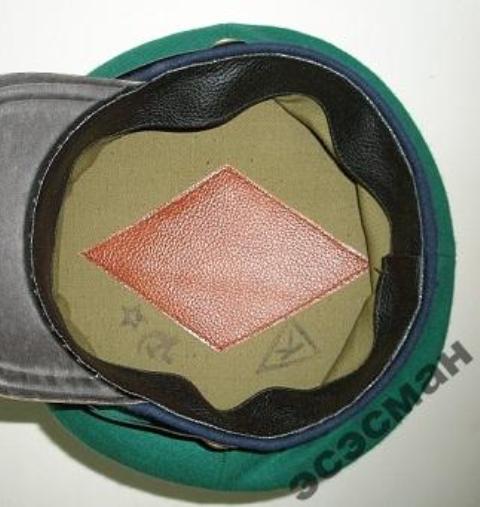 Chinstraps, buttons and cap stars also look better and may even be original (often the stars are real brass and enamel ones from the 40's and 50's and buttons are from the correct time period). Luckily, producers continue to neglect the interior of these caps. Most replicas remain devoid of maker labels or markings. Unfortunately, a few other fakes have very recently been showing up with bogus interior markings (see to the left) and with linings and sweatbands quite close to originals.
Fortunately, all of these caps look new - because they are! Not a flaw on them - no wear, no staining, no damage, no fading. As soon as sellers start "aging" them a bit, the danger will ratchet up another notch. Again, however, just looking new doesn't automatically mark a cap as fake. A number of old, authentic caps were sold right out of former Soviet museums - and many of these have never been worn and are in excellent condition. So the condition of the cap alone cannot be used to determine authenticity - you must look at other factors as well (as we will discuss).
Chinstraps, buttons and cap stars also look better and may even be original (often the stars are real brass and enamel ones from the 40's and 50's and buttons are from the correct time period). Luckily, producers continue to neglect the interior of these caps. Most replicas remain devoid of maker labels or markings. Unfortunately, a few other fakes have very recently been showing up with bogus interior markings (see to the left) and with linings and sweatbands quite close to originals.
Fortunately, all of these caps look new - because they are! Not a flaw on them - no wear, no staining, no damage, no fading. As soon as sellers start "aging" them a bit, the danger will ratchet up another notch. Again, however, just looking new doesn't automatically mark a cap as fake. A number of old, authentic caps were sold right out of former Soviet museums - and many of these have never been worn and are in excellent condition. So the condition of the cap alone cannot be used to determine authenticity - you must look at other factors as well (as we will discuss).
Faking an Older Cap
To help determine if a cap is a fake (or at least less than it's advertised to be) I have come up with a list of "things to look for" when considering an older Soviet cap (1950's and earlier).
- 1. Crown size. All caps made prior to 1969 had a small top (the "teller" shape) - usually 9 inches or less in diameter.
- 2. If it has a leather visor - it's a fake.
- 3. If anything is plastic (buttons, chinstrap, visor) - it's a fake - or has fake replacement parts.
- 4. If it is made from anything except wool or cotton - it's a fake.
- 5. If the cap star or cockade is not brass and enamel - it's wrong and the entire cap is probably a fake.
- 6. If there are no markings on the inside (either stamped on the cloth or on a sewn-on leather or oilskin label) or indications that one was on it previously (and now worn off), it's "often" a fake.
- 7. If it looks brand new - it's probably a fake. However, this is less certain, since a number of authentic caps coming out of museums look "almost" brand new.
If a cap tests positive for two or more of these elements - you can be 99% sure it is a fake!
Please note: I am not "against" reproductions in theory. Many are well made and allow collectors to acquire "representative" caps that they could not afford otherwise. AS LONG AS YOU KNOW THEY ARE FAKE! (and don't pay more than $25-40 for one).
"Legitimate" Reproductions
These are caps which were never meant to enter the collector market - the "honest" fakes. Prior to 1991, some reproductions were made of common Soviet uniforms for the Western movie industry (in contrast, Soviet movies usually drew on stocks of real uniforms items stored just for that purpose); for reenactment, for military recognition training, and museums. These were usually rather crude items, especially in the finishing details (cheap fabric, no markings on the inside and poor standards of stitching, for example). Only the external appearance mattered - and that only needed to be convincing at a distance. These would eventually appear for sale in very small numbers, but they were never a threat to "real" collectors. There were a few high quality reproductions that came out of Hong Kong such as the replica Border Guard uniforms made for the movie "Red Dawn" and more recently, some very well made WWII replicas for the movie "Stalingrad", but these were still easily identified by experienced collectors.Shown below are a couple caps used in a German movie in the 1980's. The fabric was polyester rather than the correct wool/cotton - only the cockades and buttons are authentic. The chinstraps were originally German as well (I replaced one with gold Soviet cords).
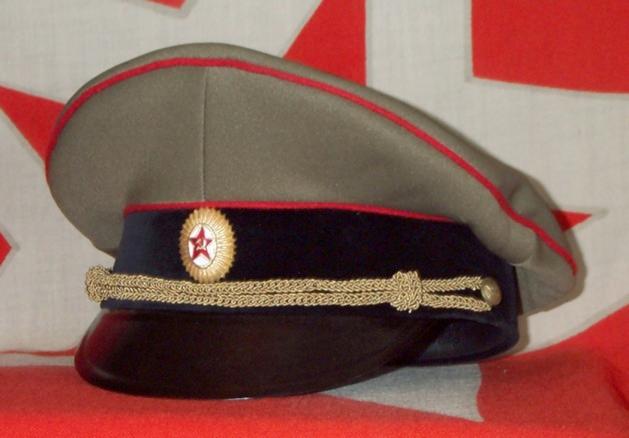
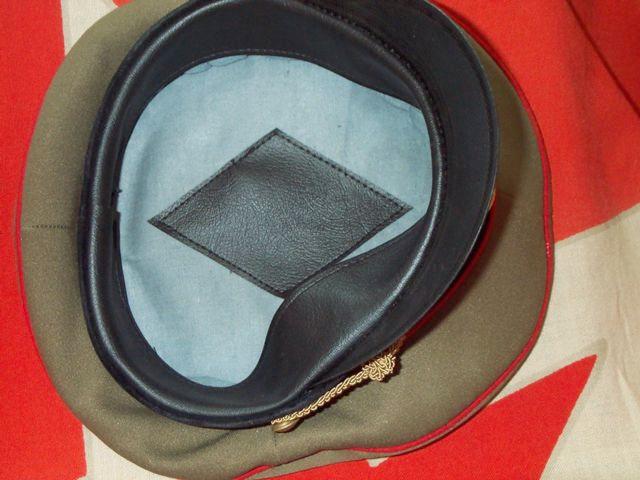
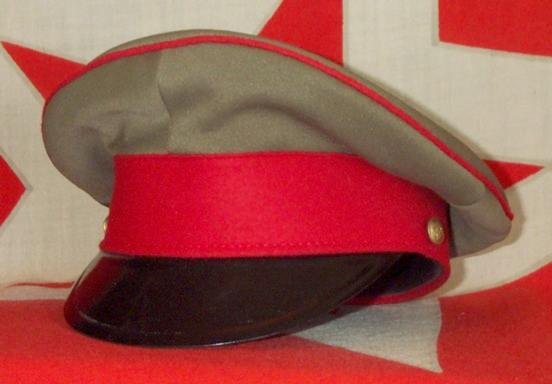
Legitimate Russian-made reproductions also exist of some older uniform items. These were manufactured primarily for historical parades and displays (such as the 50th Anniversary of the end of WWII parade in Red Square). Some of these have been exported and offered for sale in the West, although most of the ones I have seen have been correctly identified as reproductions.
None of these pose much of a threat for the observant collector - which is NOT the case of the next group we will discuss.
False Advertising
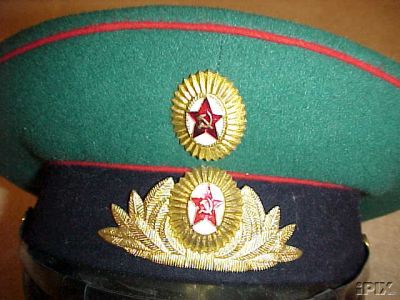
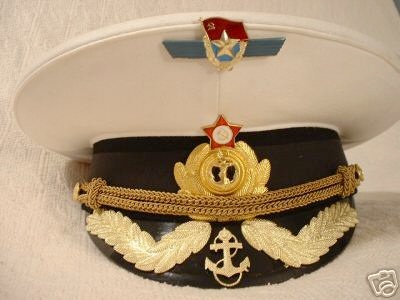
I believe the second greatest problem facing a novice cap collector comes from authentic caps improperly "badged up". I would guess that 25-50% of all caps offered for sale have wrong badges or cords attached. These usually reflect the seller or some middleman trying to make the cap more attractive to prospective buyers. The more gold bits attached the better, right? The old joke about men being attracted to shiny things is dangerously close to the mark here. Fortunately, most of these errors are correctable by simply unpinning the wrong emblem and replacing it with the correct one (simple if you have it!), or swapping out the chin strap/cords. But watch out for anything pinned to the crown of the cap or the sides of the band. Unless you know that type cap should have an emblem there (Air Force or Railroad wings for example) - don't buy it. A hole in the crown or band cannot be easily repaired and will be apparent as a flaw to most anyone viewing it.
Be especially suspicious of caps advertised as "Marshal's". It is not widely known but is a fact - that "regular" Marshals' and Chief Marshals' caps were identical to Generals' caps. Only Marshals of the Soviet Union (MSU) wore the more lavishly embroidered caps one thinks of when you hear "Marshal".
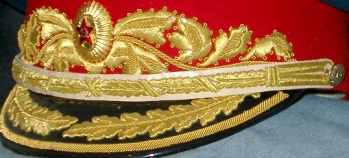
 Most caps advertised as "Marshal" are actually General's caps. In many cases, the seller himself is just ignorant of the difference, but make sure you know what you're getting for your money. A MSU cap, as you can imagine, is worth much more than a General's. MSUs had a unique pattern of embroidered leaves on the band, visor and chin strap (MSU here on left; general here on right). Just having a lot of embroidery doesn't make it a Marshal's hat.
Even when purchasing a General's cap advertised as such, make sure it is complete. The greatest threat comes from having the wrong cockade attached. A General's/Marshal's cockade has an unpainted gilt metal background behind the red star (on the right in this picture) - not the white enamel one used on cockades for colonels and below.
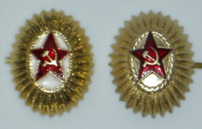
Real generals' cockades are somewhat difficult to buy separately, so make sure the cap has the right one before buying it (or if you do buy it, pay less for an "incomplete" cap). The seller may not even know the cap has the incorrect cockade but he/she may also be counting on your ignorance to pull a fast one. This "a sucker is born every minute" attitude is certainly not limited to sellers here in the US. In 1990, when I visited the Red Army Uniform Museum outside Moscow, I was offered a General's Papakha (red-topped winter wool hat) for $75 by the director of the museum. I accepted (good deal at the time), but noticed it had a regular officer's cockade attached and protested that fact. The director tried to bluff his way by insisting it was the correct badge, but when I asked my translator (an Army colonel from the Military History Institute) if I was correct, the colonel smiled and told the director to get me the correct badge - which he proceeded to take off one of his own display uniforms and replace with the incorrect one!
Post-1991 Production
We need to also discuss the issue of post-1991 Russian (or Ukrainian or Belarus or - you get the idea) manufacture of Soviet-style items. This situation has some elements in common to the post WWII production of Nazi items in Austria. Are items fakes if they are assembled using the same materials, identical methods, and in the same factories as the "originals"; just because they were made "after-the-fact" (post 1991)? Many former Soviet military clothing factories and independent uniform tailors continued to produce their products after 1991.
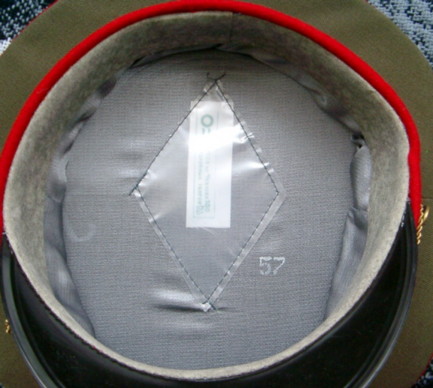
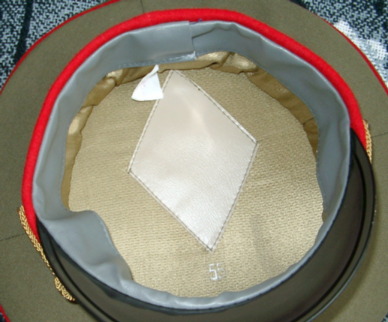
Shown here are inside shots of two Army caps made in Kiev, Ukraine in the 90's; one dated 1992, the other undated. Note the light felt sweatband and the clear plastic diamond holding a cloth manufacturer's tag on the first one - neither of which were used on Soviet era military caps. The second is a little more "standard", but it too has an odd light gray sweatband, a little cloth tag attached to the inside band and a brand new, yet blank, maker's label - all indications of post 1991 manufacture.
Much of this post-1991 production reflected the slow pace of national uniform reform after the collapse of the USSR. In fact, most uniform items and emblems used by the Soviet Army remained in use by the new Russian Army and other former Soviet republics until 1995.
Two other notes on post 91 production:
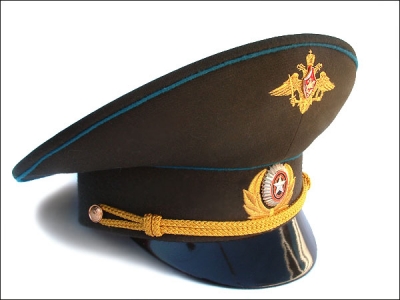
If the crown of the cap is ridiculously large (like this Russian one on the left)
it's post 1991! Caps with very exaggerated size crowns appeared in small numbers in the early 1990's but were adopted as the Russian military standard in the mid-90's. The Russian military has recently reverted to a smaller size crown - but needless to say, some of the "cartoon-tops" are still out there.
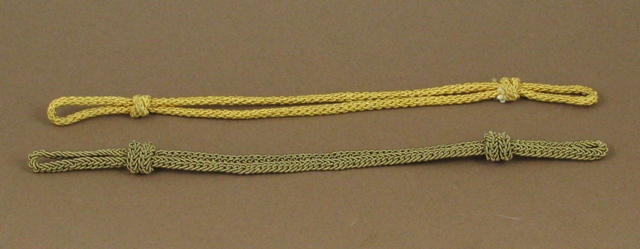
If the cords on the cap are made of yellow thread - vice metalized gilt - it "almost certainly" is a post-1991 replacement. One of each of these cords are shown on the right. While the yellow cords were not authorized for the military, it does appear that they were worn in very small numbers
by Militia officers and non-defense ministries. However, the metalized cords were clearly preferred even in these other ministries.
In the last 10 years I have seen more and more of the plain yellow cords appearing both for sale and in actual Russian use, especially in non-military organizations. But every now and then you will even see a Russian general wearing them.
As a bottom line: I would consider the appearance of such cords on "Soviet" caps "suspicious" at the least, and bogus in all probability.
Not Regulation but Authentic
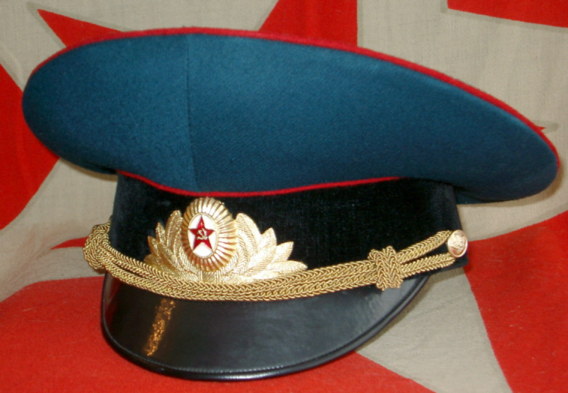
Not all "odd-looking" caps are necessarily fake, however. The armor officer's parade cap shown here that I acquired in the 1980's represents a non-regulation cap that was probably produced on consignment by a small tailor shop for an officer that wanted a more substantial cap than provided by the standard military uniform store (Voentorg).
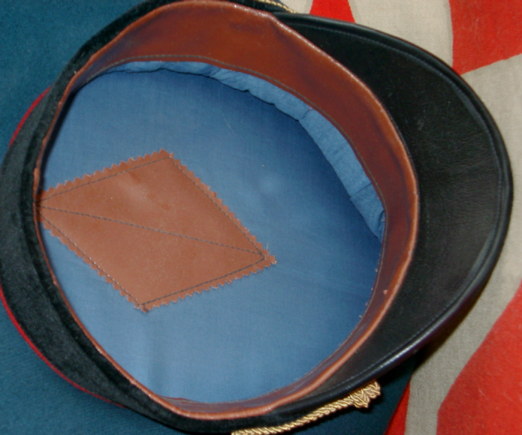 It is quite well made, with regulation fabric, buttons, emblem & chinstrap. However, it is clearly custom made, using non-regulation visor and lining materials, a slightly non-regulation style, and no markings at all - even though it has a blank leather maker's label sewn onto the inside top. Non-regulation examples such as this are comparatively rare except for the Navy, Aeroflot and Merchant Marine (MORFLOT) - where they are more commonly found.
Another instance of non-regulation but authentic, this time in a soldier's cap, is shown here.
Although Soviet conscripts were usually strictly bound by uniform regulations, there was one outlet for their sartorial imagination - that being their so-called "demobilization" uniform. 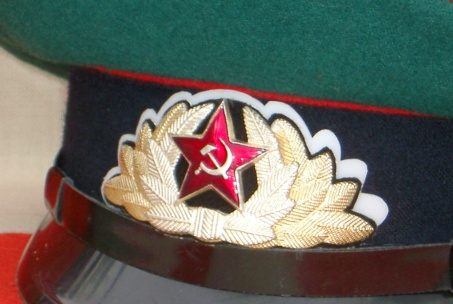 This was a uniform lovingly put together during the final six months of the conscript's service which he wore after leaving his unit and on his way home. Since conscript's uniforms were rather basic, demobilized soldiers would "fancy them up" with all sorts of non-authorized elements, including modified officer emblems and hand-made metal, plastic and cloth items. Soviet officers "usually" turned a blind eye to these upgrades as long as the conscript only wore it on his last day as he was leaving the unit. Although uniform jacket modifications were relatively common, "de-mob" enhancements of caps were rather rare. The Border Guard cap shown here is the only one I've seen in this category.
It is a basic late 80's-early 90's style cap in all respects except for the cockade, which is an imaginative (and impressive) combination of the soldier's parade star superimposed (in order) on a cut-out officer's parade cockade, which was then attached to a cut-out black felt wreath and then to a white plastic backing.
This was a uniform lovingly put together during the final six months of the conscript's service which he wore after leaving his unit and on his way home. Since conscript's uniforms were rather basic, demobilized soldiers would "fancy them up" with all sorts of non-authorized elements, including modified officer emblems and hand-made metal, plastic and cloth items. Soviet officers "usually" turned a blind eye to these upgrades as long as the conscript only wore it on his last day as he was leaving the unit. Although uniform jacket modifications were relatively common, "de-mob" enhancements of caps were rather rare. The Border Guard cap shown here is the only one I've seen in this category.
It is a basic late 80's-early 90's style cap in all respects except for the cockade, which is an imaginative (and impressive) combination of the soldier's parade star superimposed (in order) on a cut-out officer's parade cockade, which was then attached to a cut-out black felt wreath and then to a white plastic backing.
One last thing...
When you look at a cap you suspect for some reason may be a fake, keep in mind that a very large number of factories and private makers produced uniform caps in the USSR. Enlisted troops and junior officers typically wore items manufactured at Government uniform factories that were either issued to the troops or sold at military uniform stores (Voentorg). However, many senior officers and all general officers bought higher-quality caps from special military tailor shops. These did not have the official acceptance and control stamps their poorer cousins "usually" did (some authentic caps are missing these stamps as well, due to sloppy factory practices). But even these higher-grade caps almost always had a leather (or leatherette) maker's label sewn on the inside lining of the cap indicating the manufacturer and the size (and in most cases, its year of manufacture). The numerous sources of manufacture resulted in some natural variance in the appearance of the caps - although adherence to uniform regulations seems to have been generally good. Most differences in authentic caps are limited to the type and position of markings and in the material used for the linings and sweatbands of the caps. More variation existed in Navy and MORFLOT caps than others, where different materials were routinely used for visors and cap bands. Also remember that military caps were made in Eastern Europe for the occupying Soviet forces. These may vary a bit more in fabric composition and crown size (ending up looking a bit more "German" than old Soviet), but even these followed Soviet regulations in most aspects.
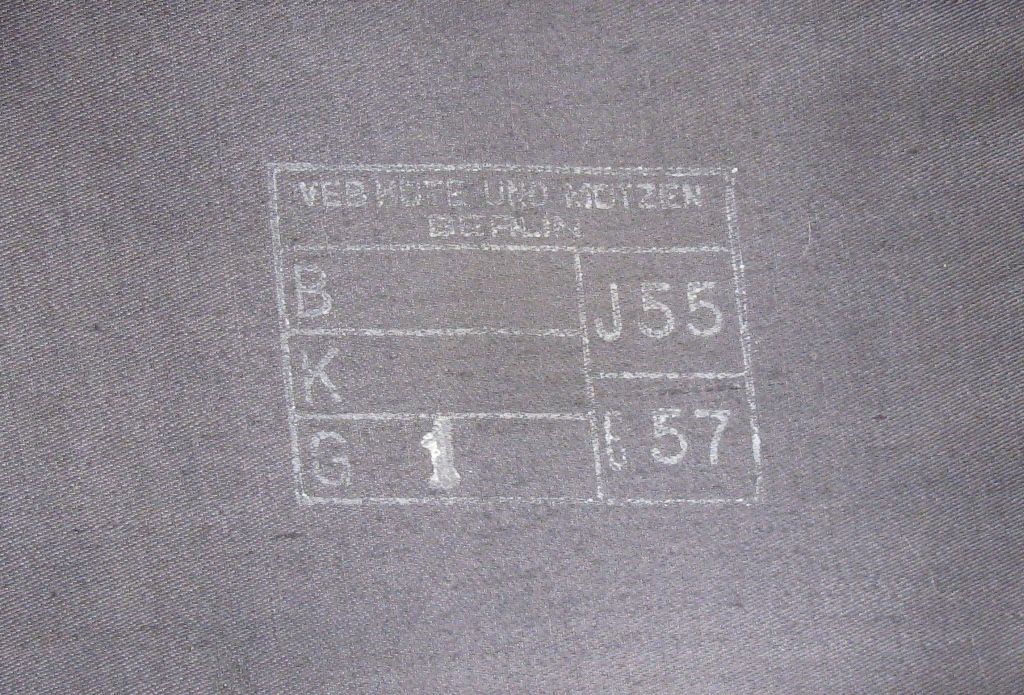
Shown here is an Armor officer's "Zhukov" style parade cap made in Berlin in 1955. All elements of the cap are identical to Soviet-made caps except for the lining and the German Democratic Republic maker marking.